Area Calculator: Calculate the Area of 30 Shapes — or Draw Any Irregular Shape
CalcNest’s Area Calculator works out the area of common two-dimensional shapes — rectangles, triangles, circles, ellipses, irregular boundaries, and more — from the measurements you enter. Choose a shape, fill in its dimensions in the unit you prefer, and the tool returns the area along with the formula behind the result.
Area Calculator Overview
Pick a shape and a diagram appears showing exactly which measurements it needs — a base and height for a triangle, a radius for a circle, two parallel sides and a height for a trapezoid. Enter those values, and the area appears immediately, along with the formula used and the calculation steps.
Regular shapes like rectangles and circles produce a precise, formula-based result. Irregular and freehand-drawn boundaries are treated as estimates instead, since there’s no single fixed formula for an uneven outline.
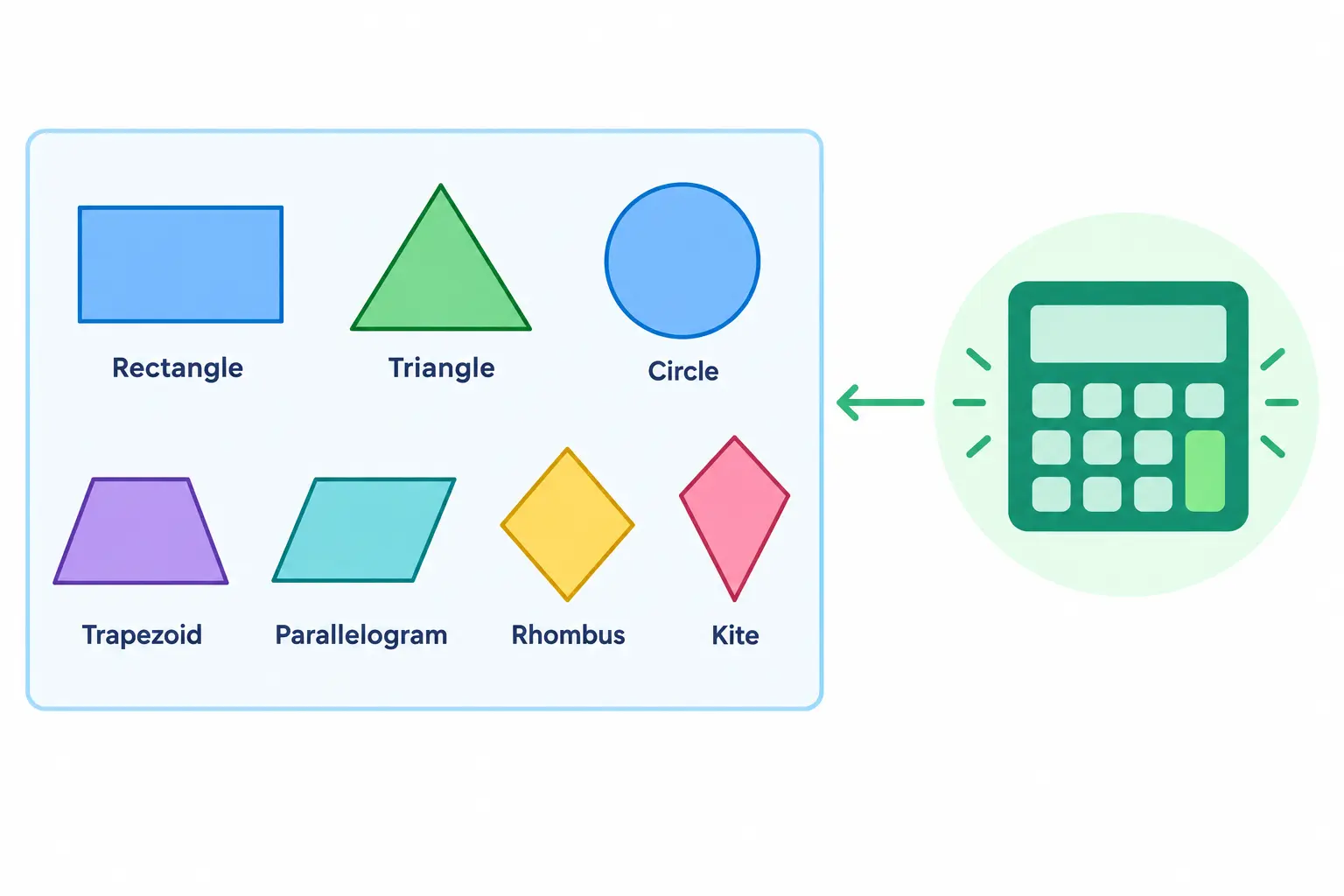
How to Use the Area Calculator
The calculator works in one of two modes: preset shapes or draw your own. Pick whichever matches what you’re measuring.
For preset shapes
Start by selecting the shape that most closely matches what you’re measuring. The calculator displays the relevant diagram and measurement fields for that shape.
- Choose the shape. Select from 30 presets — rectangle, triangle, circle, ellipse, trapezoid, polygon, and more.
- Read the diagram. Identify what each labelled measurement represents before entering a number.
- Enter the required measurements. Depending on the shape, these may include length, width, base, height, radius, diameter, diagonal, or angle.
- Keep units consistent. Use meters for all dimensions when calculating in square meters, feet when calculating in square feet.
- Add optional measurements when available. Some shapes accept extra dimensions that can refine or verify a result.
- Calculate the area. The result appears along with the formula and the steps behind it.
- Review the working. This confirms the correct measurements were used with the correct formula.
- Check the final unit. An area result uses square units such as m², ft², or cm² — not plain meters or feet.
For irregular shapes — draw your own
When nothing preset fits, use one of the two drawing tools.
Precision Draw:
- Select Precision Draw from the drawing options.
- Click to place points along the boundary of the shape, one at a time, in order around the outline.
- Close the shape by clicking the starting point again, or pressing the close/calculate button.
- Review the outline before calculating — adjust any misplaced points if needed.
- Calculate to get the enclosed area.
Best for: property lines, floor plans, plot boundaries, and any shape with straight but uneven edges
Freehand Mode:
- Select Freehand Mode from the drawing options.
- Trace the outline by dragging your cursor or finger around the boundary.
- Release to close the shape.
- Check the trace — redraw if the boundary was missed.
- Calculate to get an estimated area.
Best for: curved shapes, garden beds, ponds, and quick hand-drawn estimates where speed matters more than pinpoint accuracy.
For a complete explanation of the calculator’s features, measurements, drawing tools, and calculation workflow, see the CalcNest Area Calculator User Guide.
What Is Area?
Area is the amount of two-dimensional surface a shape encloses — how much flat space it covers. Because it measures a surface rather than a distance, it’s expressed in square units: square meters, square feet, square centimeters, rather than plain meters or feet.
Which formula applies depends on the shape. A rectangle’s sides meet at right angles, so simple multiplication works; a circle has no straight sides, so its formula relies on π instead. A rectangular room that’s 5 m long and 4 m wide covers 20 square meters of floor — the same idea behind every area calculation, just applied differently by shape.
Area vs Perimeter
Area and perimeter measure two different things about the same shape.
Area is the surface enclosed inside a boundary, in square units. Perimeter is the total distance around the outside edge, in linear units — for a circle, that boundary distance is called circumference.
The distinction matters practically: area tells you how much flooring or turf you’ll need; perimeter tells you how much fencing or trim you’ll need. A yard can have a large area but a modest perimeter if roughly square-shaped, or a smaller area with a longer perimeter if it’s a long, narrow strip.
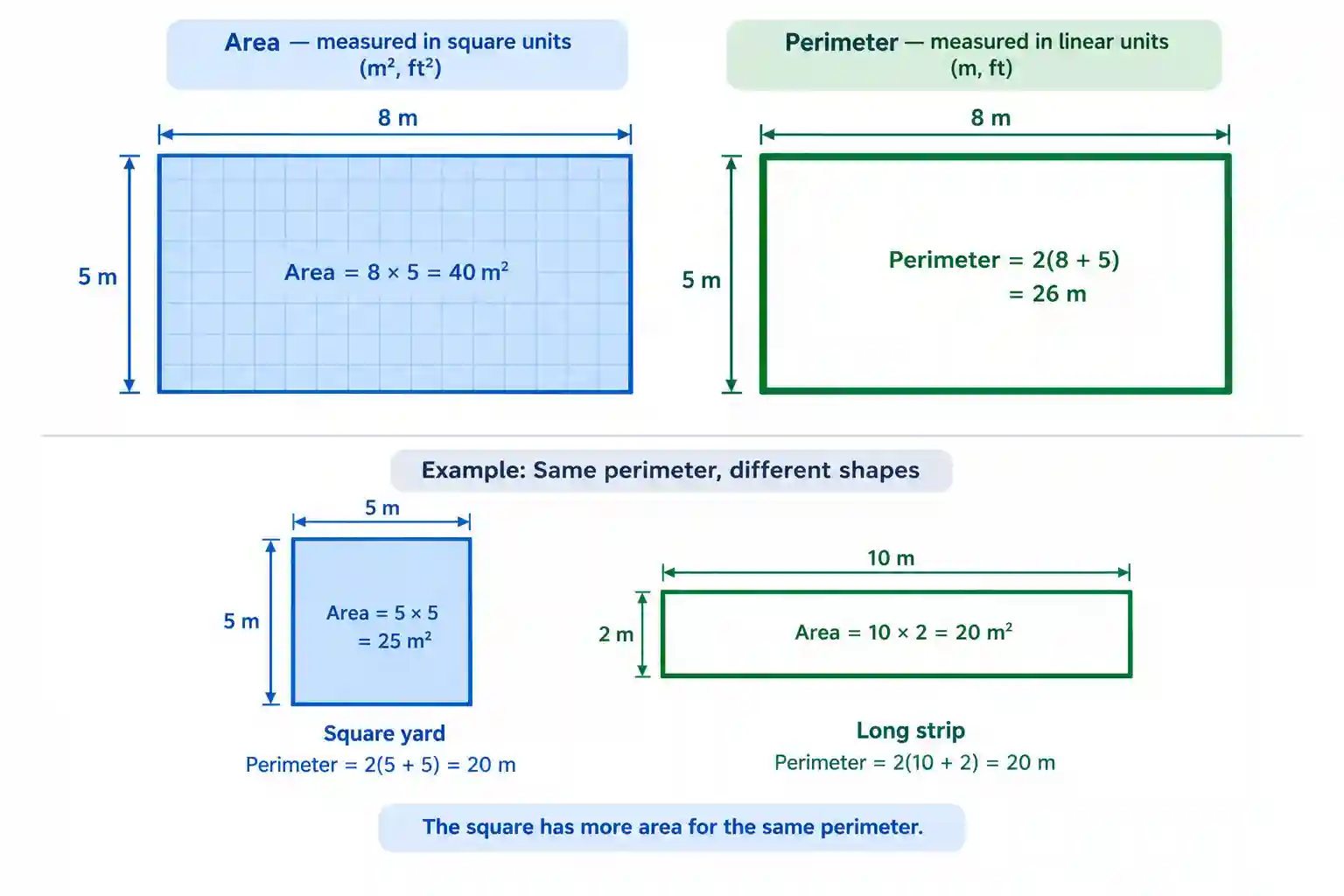
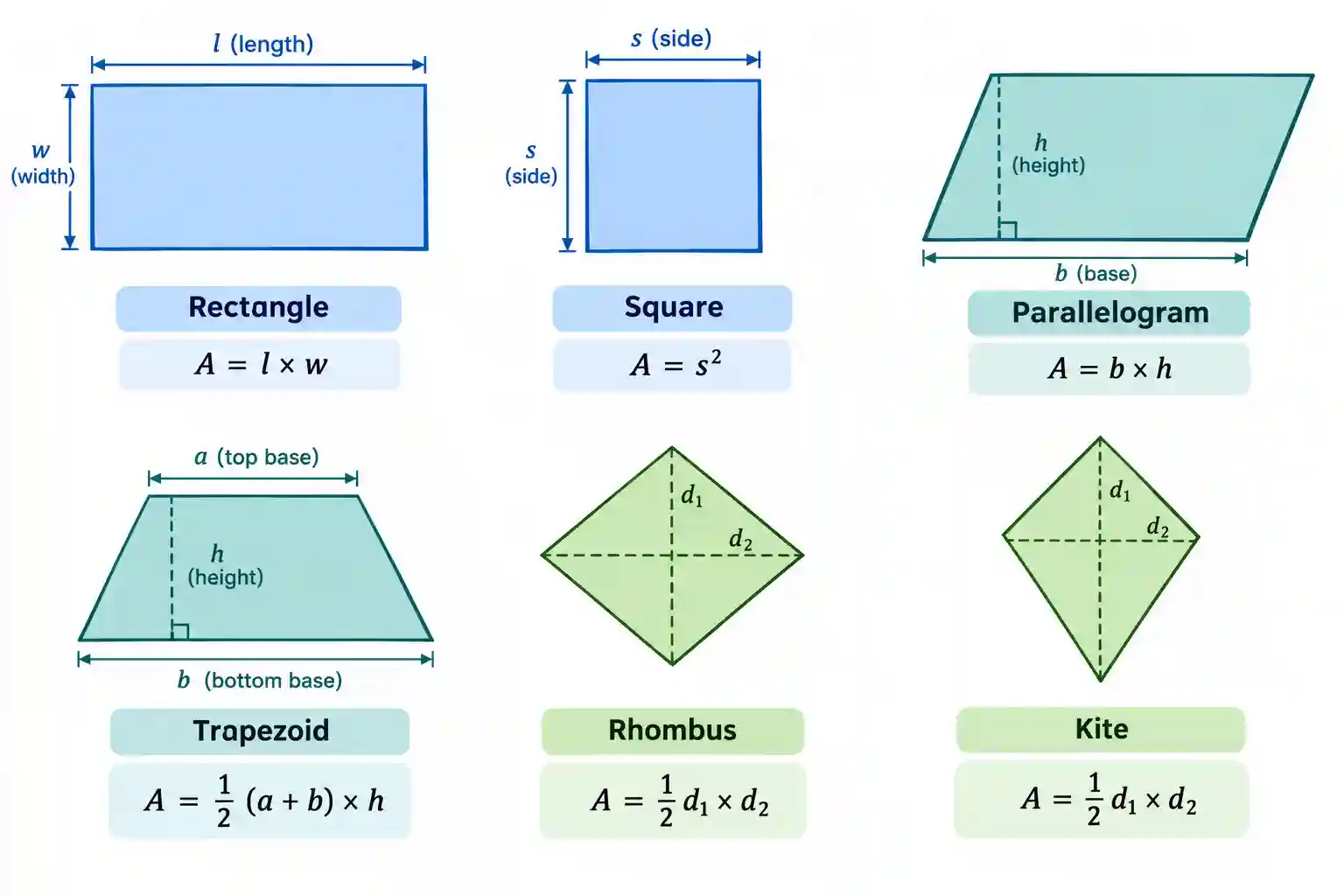
Common Area Formulas
| Shape | Formula | Main Measurements Needed |
|---|---|---|
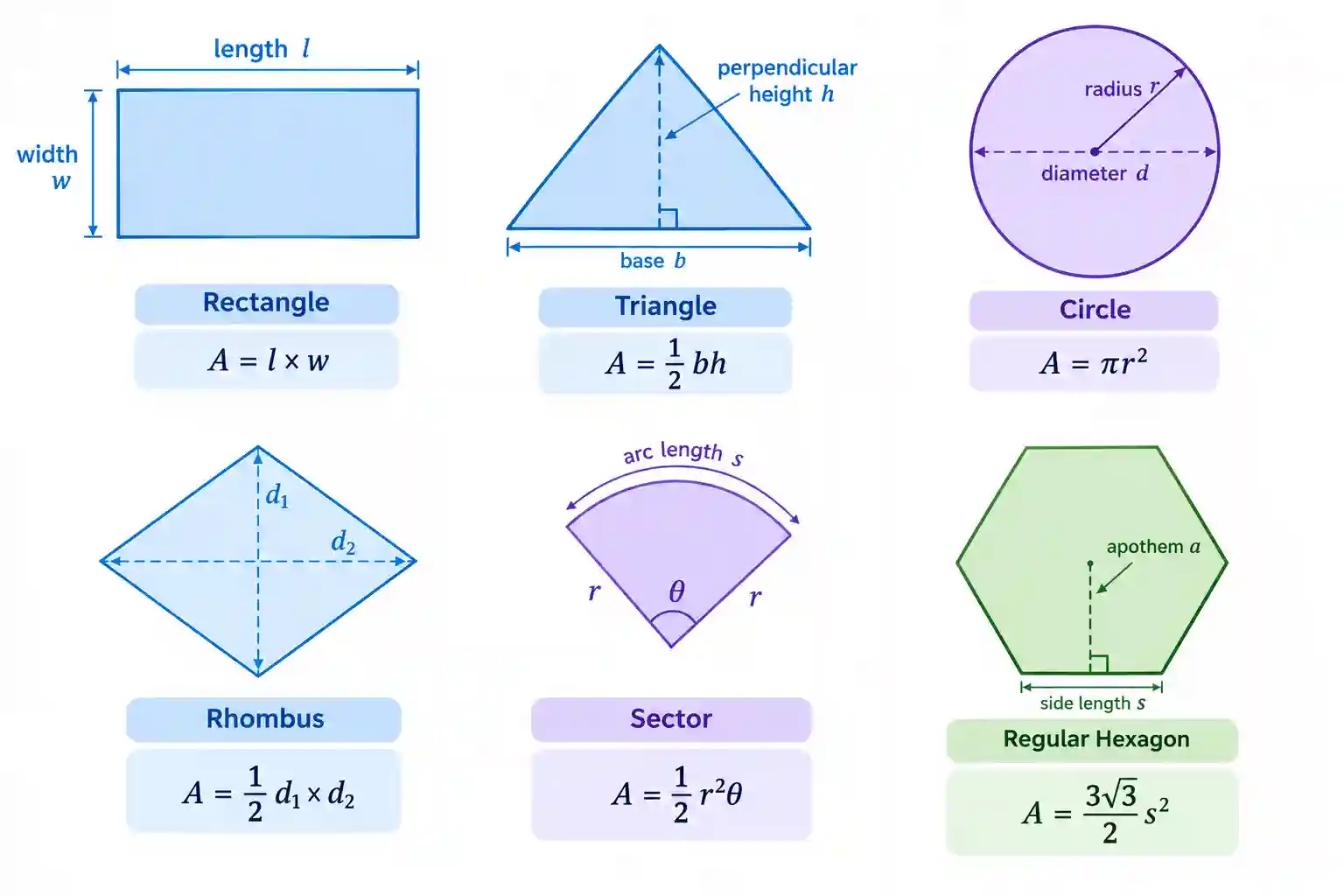
| Rectangle | A = l × w | length, width |
| Square | A = s² | side |
| Triangle | A = ½bh | base, perpendicular height |
| Circle | A = πr² | radius |
| Parallelogram | A=bh | base, perpendicular height |
| Trapezoid | A = ½(b₁ + b₂)h | two parallel bases, height |
| Rhombus | A = ½d₁d₂ | two diagonals |
| Kite | A = ½d₁d₂ | two diagonals |
| Ellipse | A = πab | semi-major axis, semi-minor axis |
| Sector | A = θ/360 × πr² | radius, central angle |
| Regular Polygon | A = ½aP | apothem, perimeter |
Area of Four-Sided Shapes
A quadrilateral is any four-sided shape, but the formula for one doesn’t necessarily work for another — a rectangle, a rhombus, and a kite can all have four sides and still need different measurements.
Rectangle
A rectangle has two pairs of equal, parallel sides meeting at right angles.
Area: A = l × w
Perimeter: P = 2(l + w)
Where: l is length and w is width.
A room measuring 6 m by 4 m has an area of 24 m². The distance around it — useful for baseboard, say — is the perimeter: 20 linear meters here, a separate figure from the 24 m² of floor area.
Square
A square is a rectangle where all four sides are equal, so its formula simplifies to A = s².
Area: A = s²
Perimeter: P = 4s
Where: s is the side length.
A 3 m square tile covers 9 m². Since length and width match, a square is really just a rectangle whose two dimensions happen to be the same.
Parallelogram
A parallelogram has two pairs of parallel sides, usually not perpendicular to each other.
Area: A = b × h
Where: b is the base and h is the perpendicular distance from the base to the opposite side — not the length of the slanted side itself.
A leaning edge 5 m long might sit only 4 m above its base at a right angle; that 4 m is h. A parallelogram-shaped bed with a 6 m base and 3 m perpendicular height covers 18 m².
Trapezoid
A trapezoid has exactly one pair of parallel sides — its two bases, usually different lengths.
Area: A = ½(b₁ + b₂)h
Where: b₁ and b₂ are the parallel bases and h is the perpendicular height between them.
A trapezoidal deck with parallel edges of 8 m and 5 m and a 4 m depth covers ½(8 + 5) × 4 = 26 m².
Rhombus
A rhombus has four equal sides, but side length alone isn’t enough for its area — the shape can flex into different angles while keeping the same sides, changing the enclosed space.
Area: A = ½d₁d₂
Where: d₁ and d₂ are the diagonals connecting opposite corners.
Kite
A kite has two pairs of adjacent sides equal to each other, rather than opposite sides matching.
Area: A = ½d₁d₂
Where: d₁ and d₂ are the diagonals connecting opposite corners.
A kite-shaped flower bed with diagonals of 4 m and 3 m covers 6 m².
If you need a more detailed calculation specifically for rectangles, including additional measurement combinations and worked examples, use the Rectangle Area Calculator.
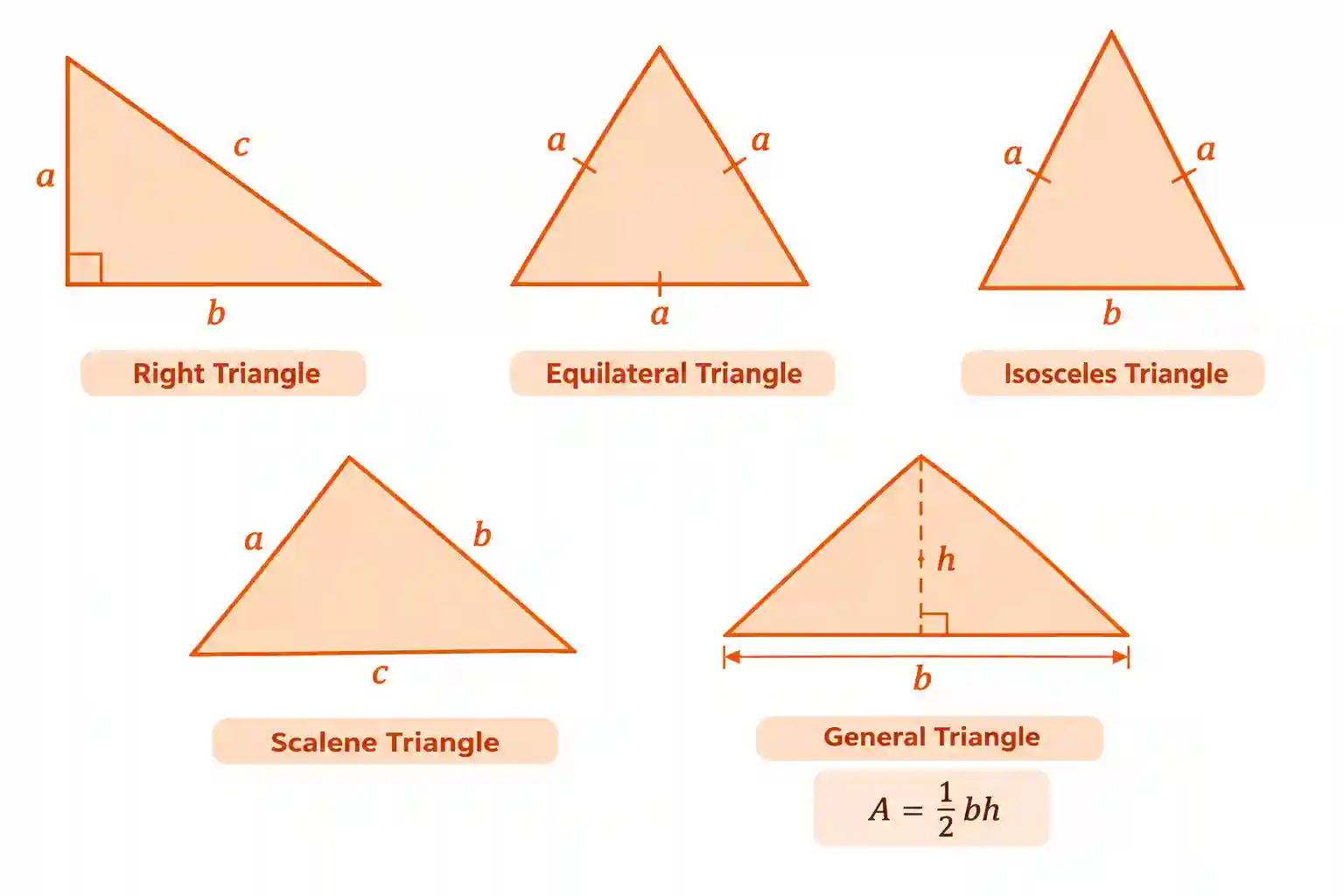
Area of a Triangle
Triangles take several forms — right, equilateral, isosceles, scalene — but the same relationship underlies all of them.
Area: A = ½bh
Where: b is the base and h is the perpendicular height from the base to the opposite vertex — not a slanted side’s length.
The Homeowner and the Corner Garden Bed
A homeowner wants to buy enough soil to fill a triangular garden bed tucked into the corner of their yard. One edge of the bed runs along the fence for 8 feet. The opposite corner sits 5 feet away from that fence line, measured straight across at a right angle.
Step 1 — Identify the base and height.
The fence-side edge is the base: b = 8 ft. The perpendicular distance from that edge to the opposite corner is the height: h = 5 ft.
Step 2 — Apply the formula.
Area = ½ × 8 × 5 = 20 sq ft.
Step 3 — Interpret the result.
The homeowner needs enough soil to cover 20 square feet. A bag that covers 25 sq ft is enough, with a little to spare.
The Triangle Area Calculator covers right, scalene, equilateral, and isosceles triangles individually, with methods suited to whichever measurements you have.
Area of a Circle and Related Circular Shapes
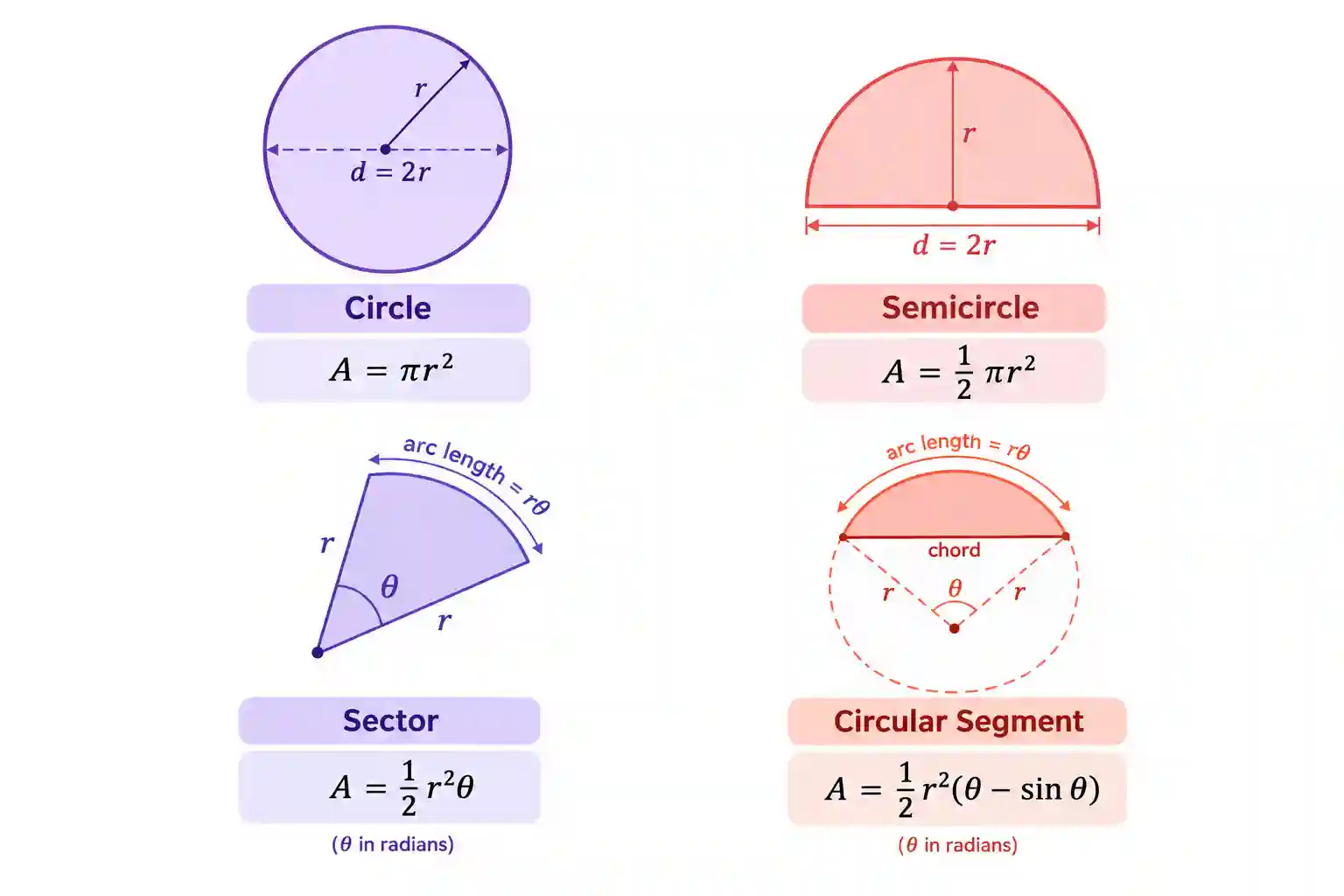
Circle
A circle is defined by its center and radius — the constant distance from center to edge.
Area: A = πr²
Circumference: C = 2πr
Where: r is the radius and d = 2r is the diameter.
The Landscaper and the Round Patio
A landscaper is pricing a circular stone patio for a client. The client wants the patio to be 12 feet across at its widest point — meaning the diameter is 12 ft, so the radius is 6 ft. The landscaper needs the surface area to estimate how many stones to order.
Step 1 — Convert the diameter to a radius.
r = d ÷ 2 = 12 ÷ 2 = 6 ft.
Step 2 — Apply the formula.
Area = π × 6² = π × 36 ≈ 113.1 sq ft.
Step 3 — Interpret the result.
The patio covers about 113 square feet. If each stone covers 4 sq ft, the landscaper needs at least 29 stones, and would order 30 to allow for cuts around the curve.
Semicircle
A semicircle is half a circle, so its area is half the full circle formula.
Area: A = ½πr²
Where: r is the radius of the full circle.
Its boundary is part curved arc, part straight diameter, so the two are usually treated separately rather than as one continuous circumference.
The Baker and the Half-Round Cake Top
A baker is decorating the top of a half-round cake — a semicircle with a straight edge and a curved edge. The straight edge is 10 inches long, so the radius of the full circle it’s cut from is 5 inches. The baker wants to know how much icing will cover the top.
Step 1 — Identify the radius from the straight edge.
The straight edge is the diameter: d = 10 in, so r = 5 in.
Step 2 — Apply the semicircle formula.
Area = ½ × π × 5² = ½ × π × 25 ≈ 39.27 sq in.
Step 3 — Interpret the result.
The top covers about 39 square inches. A small tube of icing that covers 50 sq in is more than enough for a single cake.
Sector
A sector is the pie-slice region bounded by two radii and the arc between them.
Area: A = θ/360 × πr²
Where: r is the radius and θ is the central angle in degrees.
A 90° sector of a circle with a 4 m radius covers a quarter of the full circle’s area.
Circular Segment
A circular segment differs from a sector — bounded by a straight chord and the arc it cuts off, like the shape left after slicing a flat edge off a disc. It’s less commonly needed and isn’t found the same way as a sector.
The Circle Area Calculator covers circles, semicircles, quarter circle, sectors, ring shape and segments individually, with the specific inputs each one needs.
Area of Irregular Shapes
Most real-world boundaries aren’t perfect rectangles, circles, or triangles. Property boundaries, garden beds, building footprints, road sections, and L-, T-, or U-shaped floor plans routinely have more sides or uneven angles than a single textbook formula covers.
There are two ways to handle them: break the shape down mathematically, or draw it directly in the calculator.
Method 1: Break it into simple shapes
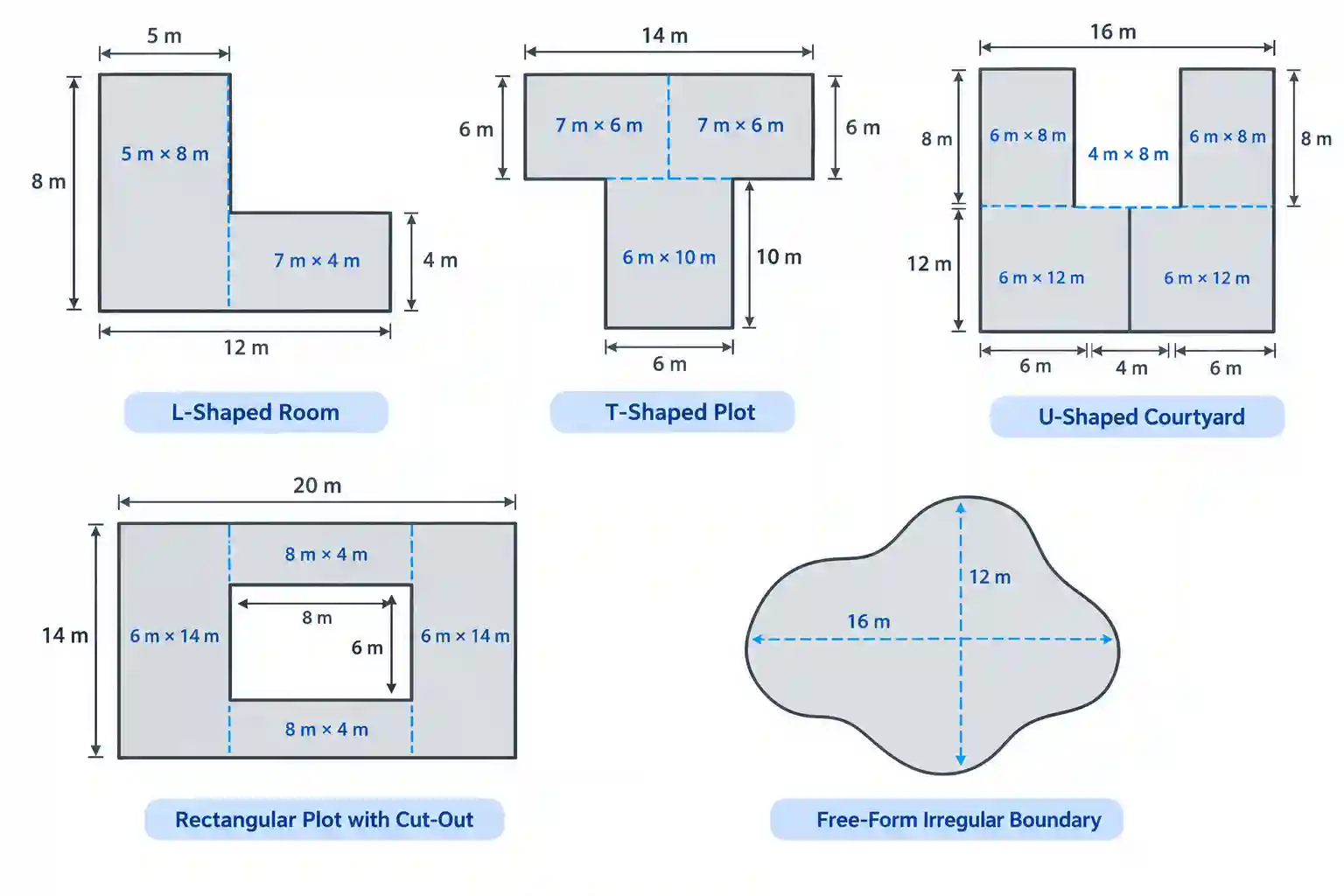
Decomposition works by splitting the irregular outline into rectangles, triangles, or parts of circles, finding each piece’s area, then adding them together — or subtracting a cut-out section if part of the shape is missing.
Total Area = Area 1 + Area 2 + Area 3 …
Or: Total Area = Main Shape − Cut-Out
An L-shaped floor can be divided into two rectangles, calculated separately, and combined for the total floor area. A U-shaped courtyard might be one large rectangle with a smaller rectangle subtracted from the middle.
The same logic works in reverse when a section is missing rather than added. A 12 m × 8 m plot with a 3 m × 3 m shed cut-out leaves 96 − 9 = 87 m² of plantable ground.
L-Shaped Living Room Floor
A couple is ordering new flooring for their living room, which has an L-shaped footprint — a main rectangular section with a smaller rectangular extension along one side. The main section measures 14 ft by 10 ft. The extension measures 6 ft by 4 ft.
Step 1 — Split the L into two rectangles.
Main section: 14 × 10 = 140 sq ft.
Extension: 6 × 4 = 24 sq ft.
Step 2 — Add the two areas together.
Total area = 140 + 24 = 164 sq ft.
Step 3 — Interpret the result.
The room covers 164 square feet. Adding 10% for cuts and waste, the couple orders enough flooring for about 180 sq ft.
Method 2: Draw the shape directly
When a boundary won’t break cleanly into rectangles and triangles — curved garden beds, irregular plots, traced outlines, floor plans with alcoves — the calculator’s drawing tools handle it without manual decomposition.
Precision Draw — place points along the boundary one by one. Each point is fixed, so the outline is repeatable and measurable. Best for property lines, floor plans, and any boundary with straight but unequal edges where you want an exact traced outline.
Freehand Mode — trace the outline by hand, and the tool estimates the enclosed area from your path. Best for curved, organic, or irregular shapes — ponds, garden beds, hand-drawn site sketches — where following the boundary by eye is faster than marking individual points.
Both modes convert your outline into an area result. The closer your points or trace follow the real boundary, the more accurate the figure. For a straight-edged polygon, Precision Draw is exact. For a freehand trace, treat the result as a close estimate — accurate to how faithfully you traced.
For irregular boundaries, drawn shapes, and land or plot situations, the Irregular Land Area Calculator is built specifically for this kind of decomposition and estimation work.
Area of Elliptical Shapes
Ellipse
An ellipse is an oval shape — essentially a circle stretched more in one direction than the other. Instead of one radius, it has two axes.
Area: A = πab
Where: a is the semi-major axis and b is the semi-minor axis — half-distances, not the full width and height.
An elliptical bed with a semi-major axis of 3 m and a semi-minor axis of 2 m covers about 18.85 m². Forgetting to halve the full measurement is a common mistake.
The Ellipse Area Calculator covers ellipse and capsule/stadium shapes with dedicated inputs for each
Area of a Regular Polygon
A regular polygon has equal side lengths and equal interior angles — a regular pentagon, hexagon, octagon, and so on.
Area: A = ½aP
Where: a is the apothem — the perpendicular distance from the center to the midpoint of a side — and P is the polygon’s perimeter.
Measurements Used to Calculate Area
Length — the distance along a side.
Width — usually the shorter perpendicular dimension in a rectangle, depending on orientation.
Base — the reference side for shapes like triangles and parallelograms.
Perpendicular height — the shortest, right-angle distance from the base to the opposite side or vertex. A slanted side is not automatically the height.
Radius — the distance from a circle’s center to its edge.
Diameter — the distance across a circle through its center: d = 2r.
Diagonal — a line connecting two non-adjacent corners, used in the rhombus and kite formulas.
Angle — needed for sector calculations and similar cases.
Apothem — the perpendicular distance from a regular polygon’s center to the midpoint of a side.
Understanding Area Units
Area is expressed in square units because it measures a surface, not a single distance. Common units include mm², cm², m², in², ft², yd², and km². For larger land areas, acres and hectares are common instead.
Keep the distinction clear: 5 m describes a single distance, while 5 m² describes an enclosed surface — not interchangeable, even though they share a base unit. Mixing this up is a common error, especially when a tape-measure reading goes straight into a calculation without squaring the unit.
Choosing the Right Calculation
Working out an area comes down to a few consistent steps: choose the shape that matches what you’re measuring, enter the right set of measurements for it, keep an eye on the unit, and check the formula and steps behind the result rather than just the final number. For a rectangle or circle, that’s usually enough for an exact figure. For an irregular boundary, treat the result as a close estimate, and use the relevant focused calculator for deeper, shape-specific guidance.
Frequently Asked Questions
How to calculate the area of an irregular shape?
Break the irregular shape into simpler sections such as rectangles and triangles, calculate each section separately, then add the areas. If the shape contains a cut-out, subtract that section instead. For more complex land or plot boundaries, use the appropriate boundary measurements or points available.
Can I calculate area if my measurements are in different units?
Convert the measurements to the same unit before applying the area formula. For example, don’t multiply a length in feet by a width in meters and expect a result in square feet. Once the dimensions use the same unit, the calculated area will be expressed in that unit squared
Why is area measured in square units?
Because it describes a surface rather than a single distance — it accounts for two directions at once, which is why the unit gets squared, like m² or ft².
What is Heron’s formula and when do I use it?
Answer: Heron’s formula calculates a triangle’s area when you know all three side lengths but not the height. If the sides are a, b, and c, first find the semi-perimeter s = (a + b + c) / 2, then apply Area = √(s(s − a)(s − b)(s − c)). For a 3-4-5 triangle, s = 6 and the area is √(6 × 3 × 2 × 1) = 6.
Can I calculate the area of a circle if I only know the circumference?
Yes. Use the formula A = C² / (4π). Divide the circumference by 2π to get the radius if you prefer the standard formula. For example, a circle with a circumference of 31.4 cm has an area of (31.4)² / (4 × 3.14159) ≈ 78.5 cm².
How do I calculate the area of a regular polygon if I don’t know the apothem?
If you know the side length and the number of sides, you can calculate the apothem first using:
a = s / (2 × tan(π/n))
Then calculate the polygon’s area with:
Area = ½ × perimeter × apothem
Since perimeter = n × s, you can also use the direct formula:
Area = (n × s²) / (4 × tan(π/n))
Where n is the number of sides and s is the side length.
Example: For a regular hexagon with 6 sides and a side length of 10 cm, the area is approximately 259.81 cm².