Triangle Area Calculator — Equilateral, Right, Isosceles & Scalene
This free triangle area calculator finds the area of any triangle in seconds. It handles right, equilateral, isosceles and scalene triangles, and it accepts a base and perpendicular height, three sides, or the equal side and base of an isosceles triangle. You get the area and the full step-by-step working, in square feet, square metres or square yards, plus the area of a triangle formula behind every answer.
About the Tool
The tool has five modes. Right Triangle takes a base and a perpendicular height. Equilateral takes one side. Isosceles takes the equal side and the base. Triangle — 3 Sides takes all three sides. Scalene Triangle also takes three sides. Use any mode to calculate triangle area and see the full step-by-step working. The tool does not accept three angles alone, because many triangles share the same angles. Enter at least one side. The working keeps full precision, and the final answer rounds to two decimal places.
How to Use the Triangle Area Calculator
- Choose the mode that matches your measurements.
- Pick your input unit: ft, m, in, cm, yd, mm, km, mi or nmi.
- Enter each value. Use positive numbers only.
- Press Calculate.
- Read the area and the step-by-step working, then pick an output unit — such as sq ft, sq m, sq yd, acres or hectares.
To see how to calculate square feet of a triangle, set the input unit to feet and the output unit to sq ft.
Which measurements does each shape need?
| Shape | Required Input |
|---|---|
| Right Triangle | Base and perpendicular height |
| Equilateral | One side |
| Isosceles | Equal side and base |
| Triangle — 3 Sides | Sides a,b,c |
| Scalene Triangle | Sides a,b,c |
All inputs must be positive. The three-side modes also check that the lengths satisfy the triangle inequality.
Triangle Area Formula — The Core (A = ½bh)
The triangle area formula is:
A = ½ × b × h
- A is the area.
- b is the base. You can pick any side.
- h is the height: the perpendicular distance from the base to the opposite vertex.
The height must meet the base at 90°. A slanted side is longer than the true height, so using it gives an area that is too big. In a right triangle, the two legs already meet at 90°, so one leg is the base and the other is the height.
Example: b = 8 m and h = 5 m. A = ½ × 8 × 5 = 20 m².
This formula works for every triangle. It is also the fastest answer to how to find the area of a triangle whenever you can measure a base and a height.
Why Is the Area Formula ½bh? (Derivation)
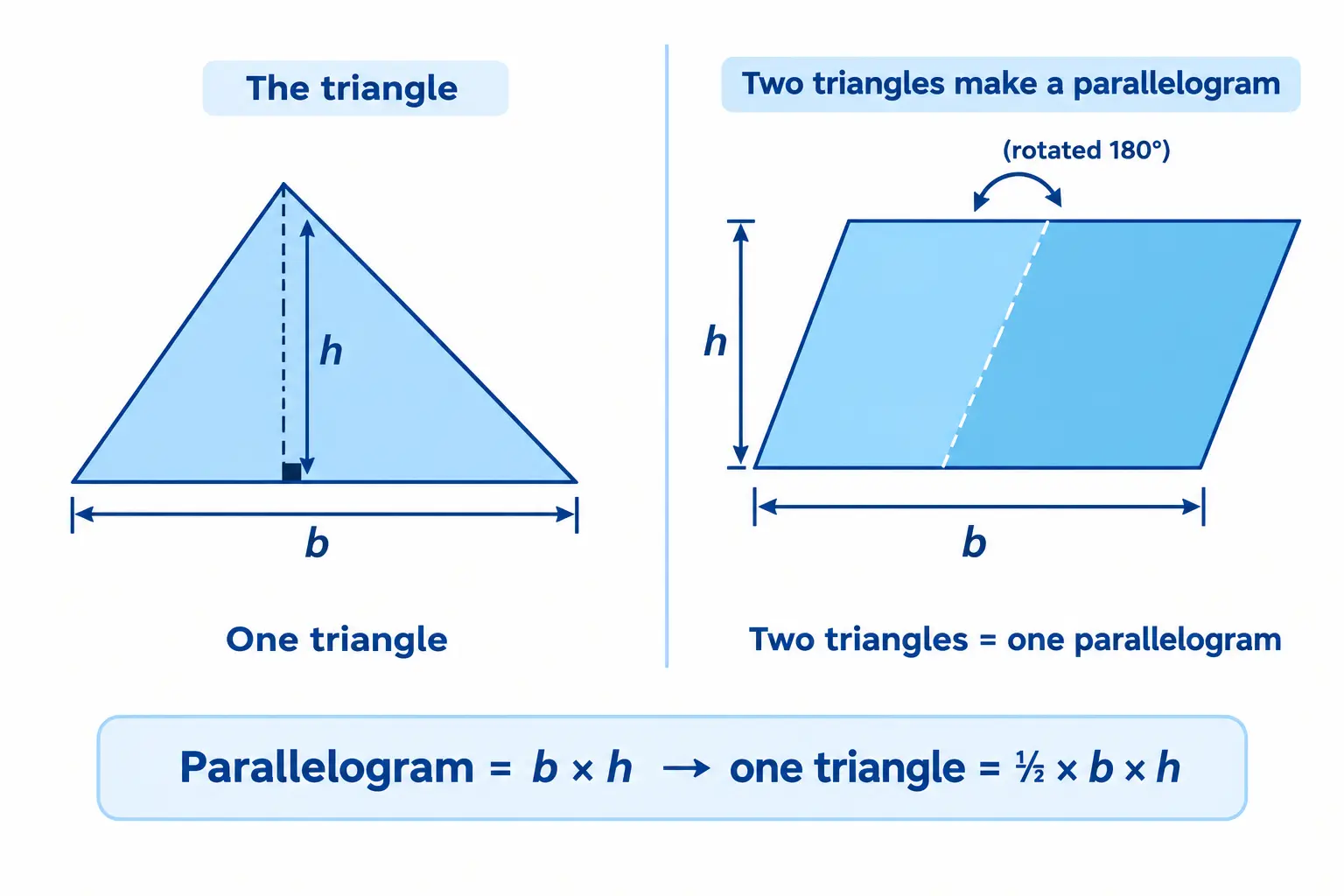
Take any triangle. Make an identical copy, turn the copy upside down, and join the two along a matching side. The two triangles form a parallelogram.
A parallelogram has an area of base × height. This one has the same base b and height h as your original triangle.
The parallelogram holds two identical triangles, so one triangle is half of it:
A = ½ × b × h
Every other area of a triangle formula on this page comes from this one. Each one is a way to find the height or the base from the measurements you do have.
All Triangle Area Formulas at a Glance
This table lists the main formula for each case. Find your triangle, check what you know, and read across.
| Triangle Type | What you know | |
|---|---|---|
| Any triangle | Base b, height h | A = ½ × b × h |
| Any triangle | Sides a, b, c | A = √[s(s − a)(s − b)(s − c)], where s = (a + b + c) ÷ 2 |
| Any triangle | Sides a, b and included angle C | A = ½ × a × b × sin C |
| Equilateral | side a | A = (√3 ÷ 4) × a² |
| Right | Legs a, b | A = ½ × a × b |
| Isosceles | Equal side a, base b | A = (b ÷ 4) × √(4a² − b²) |
The calculator supports the first, second, fourth, fifth and sixth rows. The SAS formula (row three) is shown for reference — if you need to compute area from two sides and the included angle, work it out by hand using the formula above.
The sections below explain each formula in full.
Parts of a Triangle
These terms appear in every formula on this page.
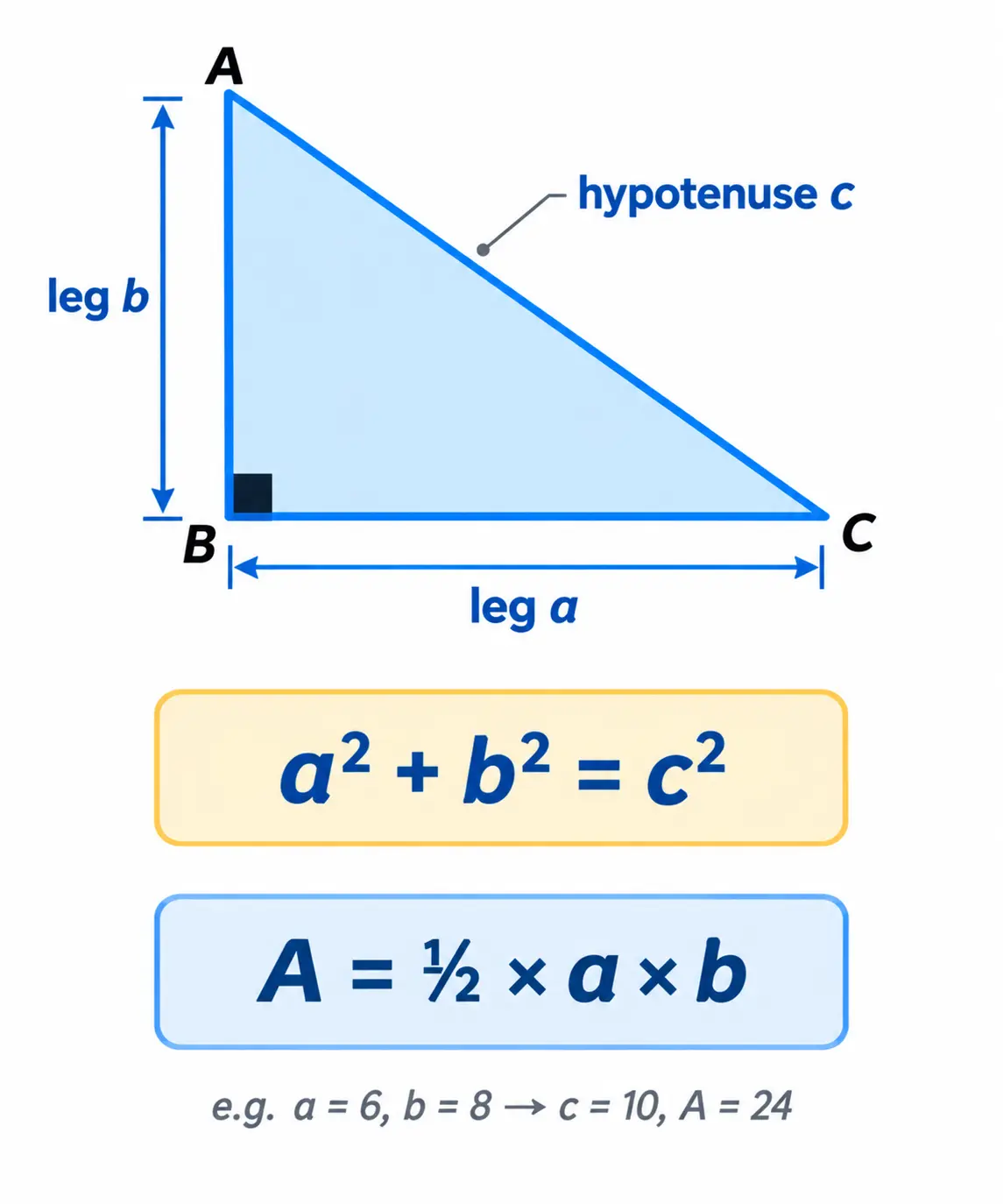
- Base (b): the side you measure the height from.
- Height (h): the perpendicular distance from the base to the opposite vertex.
- Sides (a, b, c): the three line segments that enclose the triangle.
- Vertex: a corner where two sides meet.
- Angle (∠A, ∠B, ∠C): the opening at a vertex. The three angles add up to 180°.
- Semi-perimeter (s): half the perimeter, s = (a + b + c) ÷ 2.
- Altitude: a line from a vertex that meets the opposite side at 90°. Its length is a height.
- Median: a line from a vertex to the midpoint of the opposite side.
- Inradius (r): the radius of the largest circle that fits inside the triangle, r = A ÷ s.
- Circumradius (R): the radius of the circle through all three vertices, R = abc ÷ 4A.
Equilateral Triangle__ Definition and formula
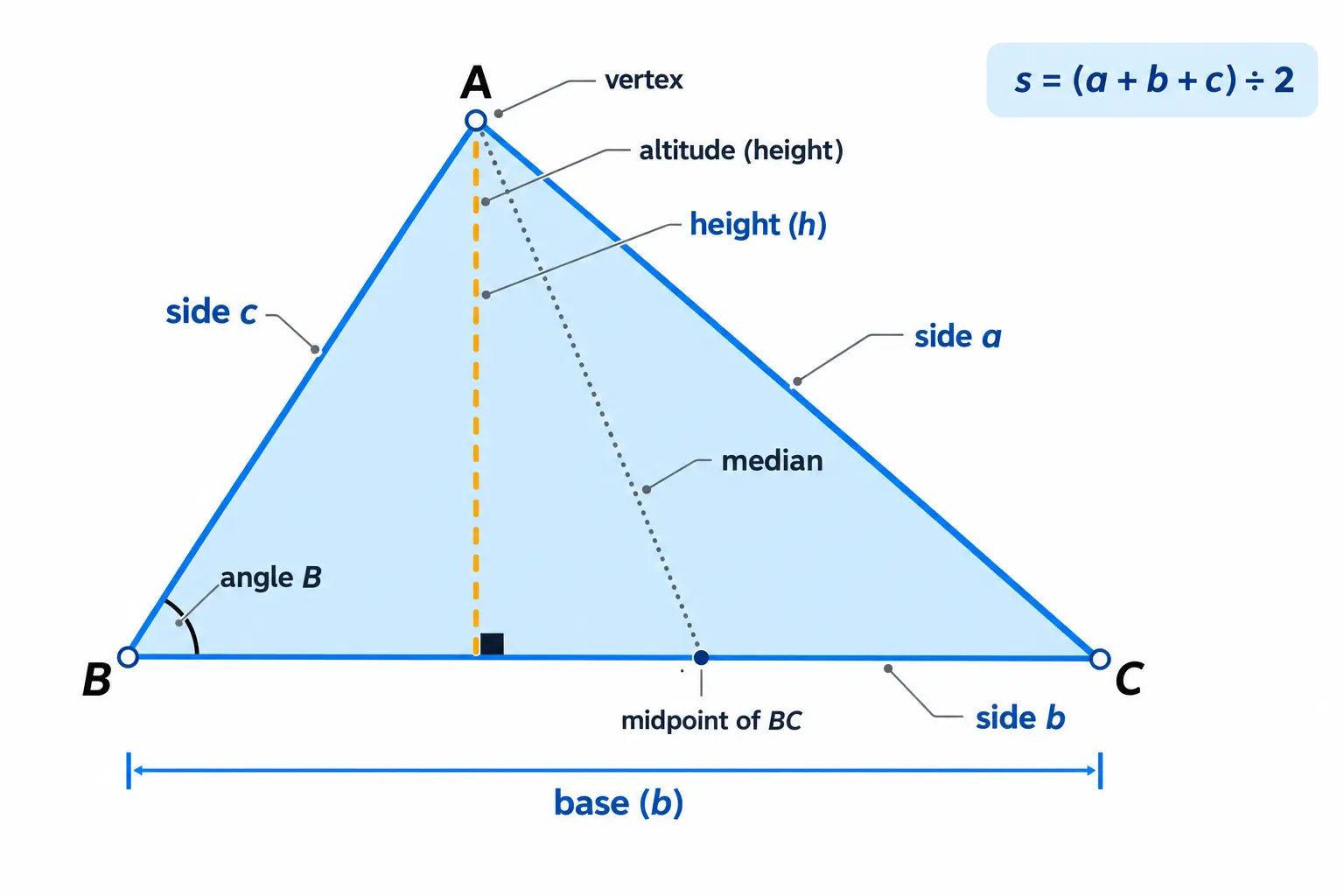
An equilateral triangle has three equal sides and three 60° angles. To find the area of an equilateral triangle, use:
A = (√3 ÷ 4) × a²
Here a is the side length. The formula comes from ½bh, because the height is (√3 ÷ 2) × a.
Special points
- Perimeter of a triangle with equal sides: P = 3a
- Height: h = (√3 ÷ 2) × a
- Inradius: r = a√3 ÷ 6
- Circumradius: R = a√3 ÷ 3
Worked example
Find the area, height and perimeter when side a = 6 m.
- Area: (√3 ÷ 4) × 6² = 0.4330 × 36 ≈ 15.59 m²
- Height: (√3 ÷ 2) × 6 ≈ 5.20 m
- Perimeter: 3 × 6 = 18 m
Check: ½ × 6 × 5.196 = 15.59 m². ✓
When to use this formula
Use it when all three sides are equal and you know one side. You do not need to measure a height.
Right Triangle __ Definition and formula
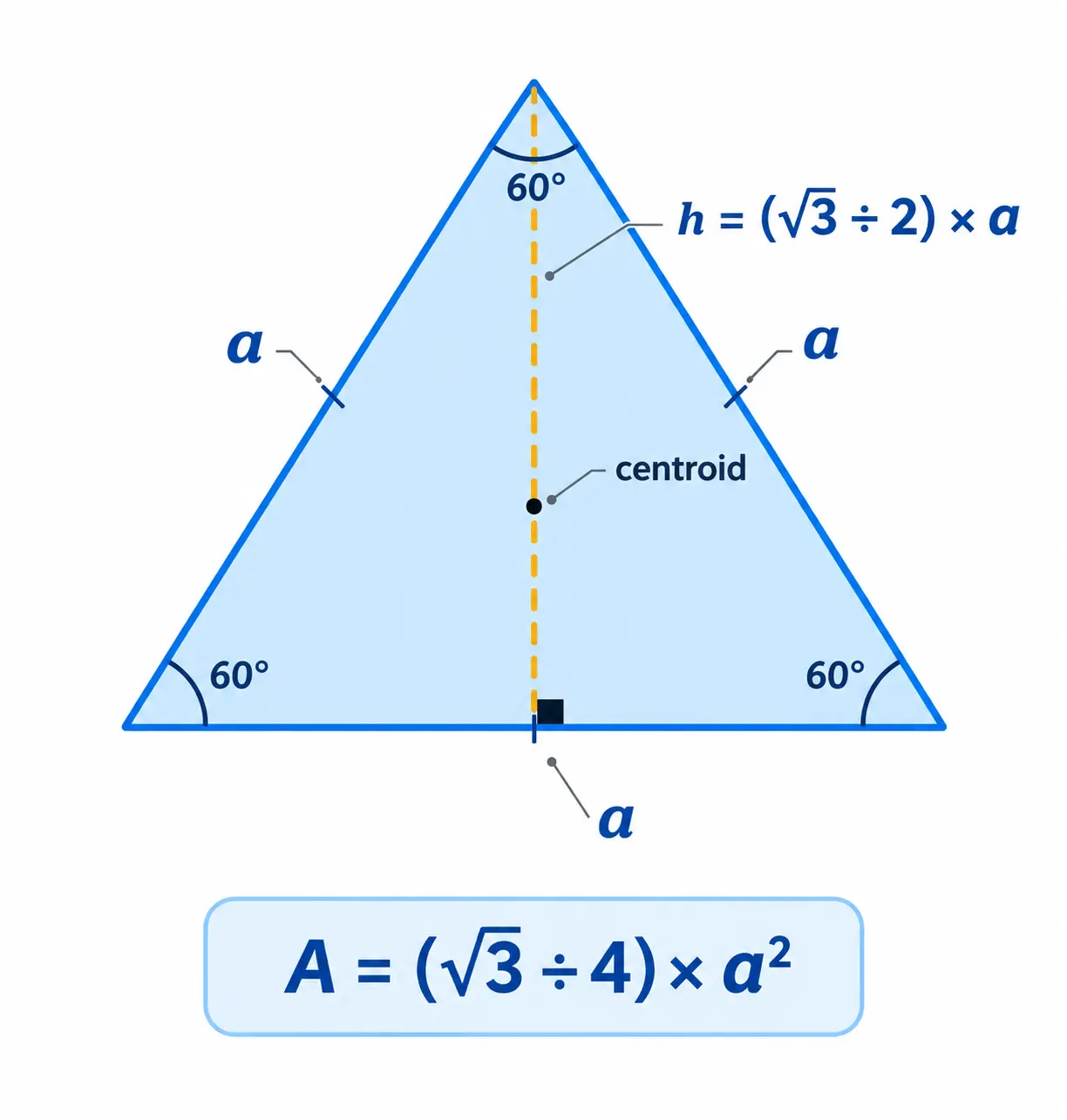
A right triangle has one 90° angle. The two sides that meet at that angle are the legs, a and b. The longest side, c, is the hypotenuse. For the area of a right triangle, one leg is the base and the other is the height:
A = ½ × a × b
Pythagorean theorem and missing sides
The Pythagorean theorem links the three sides: a² + b² = c². If you know two sides, find the third with c = √(a² + b²) or a = √(c² − b²). To find the angles, use the sine, cosine and tangent ratios.
Special cases
- 3-4-5 triangle: area = 6.
- 5-12-13 triangle: area = 30.
- 45-45-90 triangle: sides in the ratio 1 : 1 : √2. Area = leg² ÷ 2.
- 30-60-90 triangle: sides in the ratio 1 : √3 : 2. Area = (√3 ÷ 2) × short leg².
Special Points
- Perimeter: P = a + b + c
- Height to the hypotenuse: h = ab ÷ c
- Inradius: r = (a + b − c) ÷ 2
Worked Example
Find the hypotenuse and area when a = 6 m and b = 8 m.
- Hypotenuse: c = √(36 + 64) = 10 m
- Area: ½ × 6 × 8 = 24 m²
- Check: perimeter = 24 m, height to the hypotenuse = 4.8 m, inradius = 2 m.
When to use this formula
Use ½ab whenever you know both legs. If you know one leg and the hypotenuse, find the missing leg first. The Right Triangle mode does this step for you.
Isosceles Triangle__ Definition and Two Formulas
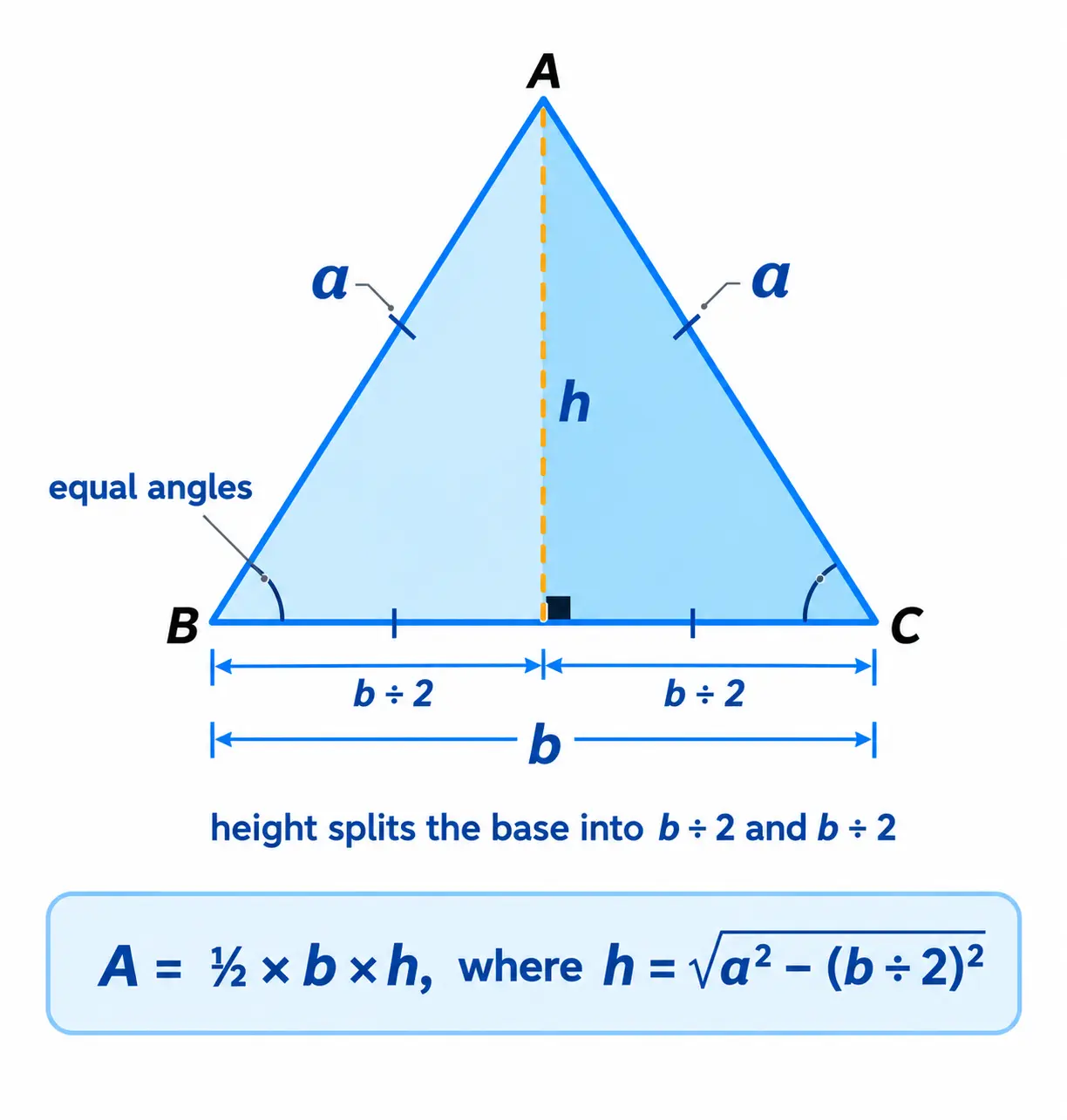
An isosceles triangle has two equal sides, a, and a base, b. The height drops to the midpoint of the base. For the area of an isosceles triangle, use either formula:
- With the height: A = ½ × b × h, where h = √(a² − b² ÷ 4)
- From the sides alone: A = (b ÷ 4) × √(4a² − b²)
Special Points
- Perimeter: P = 2a + b
- Height: h = √(a² − (b ÷ 2)²)
- Inradius: r = A ÷ s
- Base angles: always equal
To learn how to find the height of a triangle in other cases, rearrange ½bh to h = 2A ÷ b.
Worked Example
Find the area when a = 5 m and b = 6 m.
- Formula 1: h = √(25 − 9) = 4 m. A = ½ × 6 × 4 = 12 m²
- Formula 2: A = (6 ÷ 4) × √(100 − 36) = 1.5 × 8 = 12 m²
Both agree. The perimeter is 16 m and the inradius is 12 ÷ 8 = 1.5 m.
When to use this formula
Both give the area of an isosceles triangle. Use formula 1 when you know the height. Use formula 2 when you have only the side lengths.
Scalene Triangle__ Definition
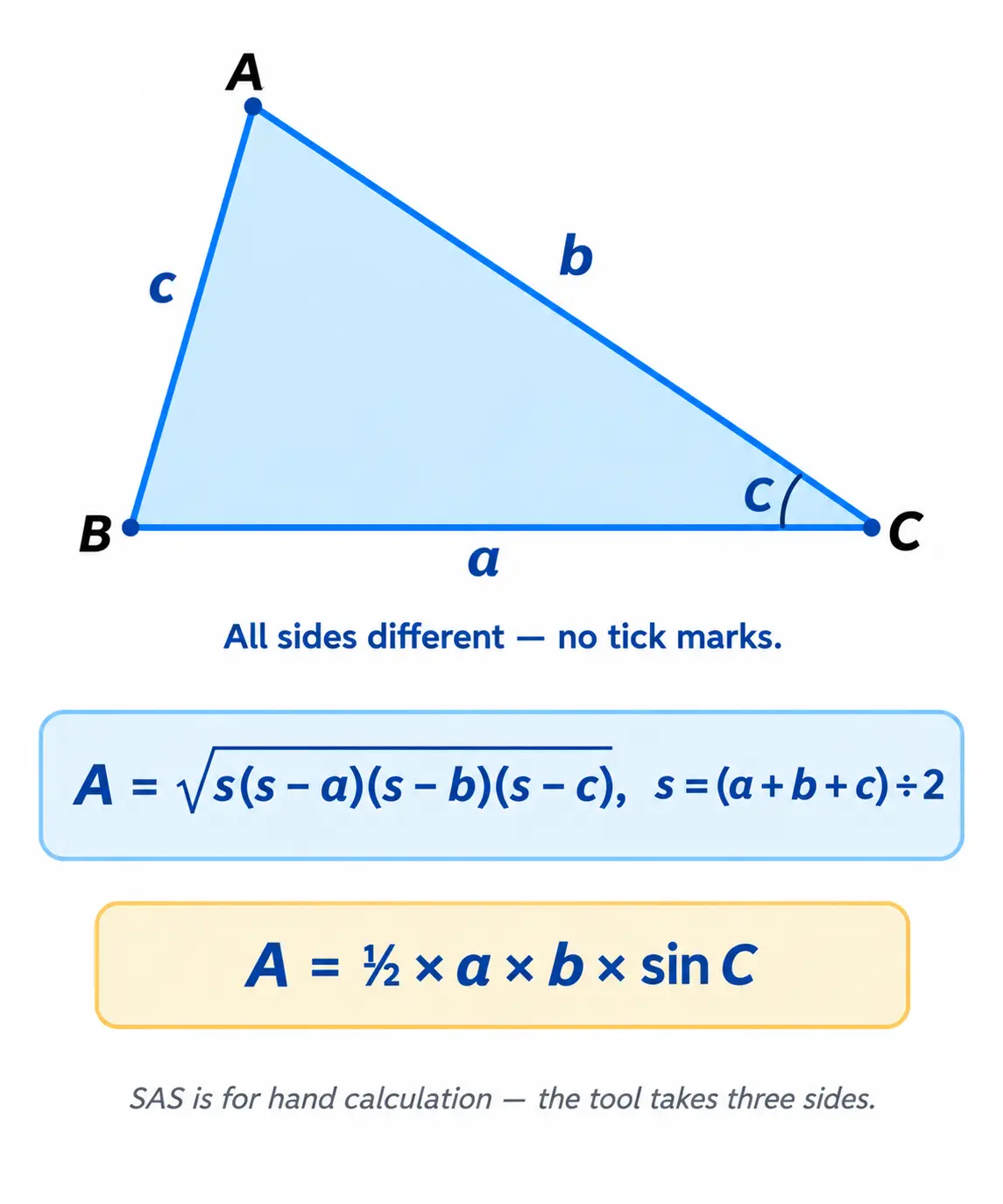
A scalene triangle has three different sides and three different angles. It has no built-in height, so you usually find the area of a scalene triangle with one of two methods below.
This is the area of a triangle with 3 sides, and it works without a height. First find s = (a + b + c) ÷ 2. Then:
A = √[s(s − a)(s − b)(s − c)]
SAS formula (for hand calculation)
The calculator does not accept an angle input — the Scalene mode takes three sides. But if you know two sides and the angle between them (SAS), you can compute the area yourself using:
A = ½ × a × b × sin C
Set your scientific calculator to degrees if C is in degrees. Our trigonometry formulas guide explains sine in full. For the tool itself, either work out the third side first and use the three-sides mode, or compute the area by hand with this formula.
Special Points
- Perimeter: P = a + b + c
- Semi-perimeter: s = P ÷ 2
- Inradius: r = A ÷ s
- Height on base b: h = 2A ÷ b
Worked Example
Example 1 (three sides). a = 7 m, b = 8 m, c = 9 m.
- s = (7 + 8 + 9) ÷ 2 = 12
- A = √(12 × 5 × 4 × 3) = √720 ≈ 26.83 m²
- Perimeter = 24 m. Inradius ≈ 2.24 m.
Example 2 (SAS — by hand). a = 5 m, b = 6 m, C = 60°.
- A = ½ × 5 × 6 × sin 60° = 15 × 0.8660 ≈ 12.99 m²
- Third side: c = √(25 + 36 − 60 × cos 60°) = √31 ≈ 5.57 m.
When to use which Formula
Use the three-side formula when you have only lengths. Use the SAS formula (by hand) when you know two sides and the angle between them. The calculator itself only supports the three-side method — compute SAS answers outside the tool.
How to Calculate Square Feet of a Triangle
Here is how to calculate square feet of a triangle: use the same formula, A = ½ × base × height, and measure both lengths in feet. The answer is the triangle area in square feet (sq ft). The triangle area calculator above also works as a triangle square footage calculator. Set the input unit to feet and the output unit to sq ft.
Example 1: base and height. Base = 12 ft, height = 8 ft.
A = ½ × 12 × 8 = 48 sq ft
Example 2: three sides. Sides = 5 ft, 6 ft, 7 ft.
s = (5 + 6 + 7) ÷ 2 = 9
A = √(9 × 4 × 3 × 2) = √216 ≈ 14.7 sq ft
To convert square feet to square metres, multiply by 0.0929. For example, 48 sq ft ≈ 4.46 m². If your measurements are in inches, convert them to feet first by dividing by 12. Now you know how to calculate square feet of a triangle from either set of measurements.
Triangle Inequality Theorem
Not every set of three lengths makes a triangle. The triangle inequality theorem says each side must be shorter than the sum of the other two:
- a + b > c
- a + c > b
- b + c > a
Invalid: 2, 3 and 10. Here 2 + 3 = 5, which is less than 10, so the short sides cannot meet.
Valid: 3, 4 and 5. All three tests pass.
If two sides add up to exactly the third, the triangle is flat and has zero area. The calculator rejects invalid inputs in its three-side modes with a clear error.
Common Mistakes
- Using a slanted side as the height. The height must be perpendicular to the base.
- Forgetting to halve. Base × height gives a parallelogram. Halve it for a triangle.
- Using the three-side formula when a shortcut exists. For a right triangle, ½ab is faster.
- Entering three angles only. Angles fix the shape, not the size.
- Mixing units. Convert every length to one unit first. Area units are squared.
- Mixing degrees and radians. The SAS formula needs the right mode. See degrees vs radians.
Real-World Uses of Triangle Area
Triangle area shows up in many jobs. Roofers measure triangular gable ends. Surveyors split land into triangles to size a plot. Carpenters check bracing and corner sections. Sailmakers size sails and banners. Designers and game developers work with triangle meshes, and engineers use triangles in trusses. The steps for how to calculate square feet of a triangle apply to all of them. The calculation is always the same. Only the units and the scale change, and you can calculate triangle area in each case with the same method.
Frequently Asked Questions
What is the difference between height and slant side?
The height meets the base at 90°. A slant side leans, so it is longer than the height. Using it in the formula gives an area that is too big. To find the height from a known area, use h = 2A ÷ b. In a right triangle, each leg is a height.
How do I find the area of a right triangle if I only know the hypotenuse?
You need one more fact. Many right triangles share the same hypotenuse. If it is a 45-45-90 triangle, each leg is c ÷ √2 and the area is c² ÷ 4. Otherwise, add one leg or one acute angle, then use ½ab.
Why does the calculator reject some side combinations?
Some lengths cannot form a triangle. The triangle inequality says each side must be shorter than the sum of the other two. For 2, 3 and 10, the two short sides cannot reach each other. The calculator shows an error instead of a wrong answer, so check your measurements.
What is Heron’s formula, and when do I use it?
It finds the area from three sides, with no height needed. First find s = (a + b + c) ÷ 2. Then A = √[s(s − a)(s − b)(s − c)]. Use it when you know only the side lengths, which is common with scalene triangles.
Can I calculate area from three angles?
No. Three angles fix the shape of a triangle but not its size. A tiny triangle and a huge one can share the same angles, so their areas differ. You need at least one side length to calculate triangle area. With one side and two angles, find the other sides first, then the area.