Area of Irregular Shapes Calculator—Free Tool & 5-Methods Guide
This area of irregular shapes calculator helps you calculate the area of uneven plots, custom polygons, and L-shaped rooms. Choose a supported preset or use Precision Draw to enter side lengths and diagonals. Depending on your measurements, the tool provides an exact mathematical result or an estimate. You get the result in square feet, square meters, Marla, Kanal, acres, or hectares. The guide below teaches every method, so you can check any result yourself — including methods this calculator does not support directly.
How This Area of Irregular Shapes Calculator Works
This calculator gives you two ways to enter a shape.
Preset Shapes
Choose Irregular Quadrilateral, L Shape, T Shape, U Shape, or Road Strip, then enter the measurements shown. Each preset uses the formula that fits its shape. The Irregular Quadrilateral splits into two triangles using the diagonal you provide, then applies Heron’s formula. The L and U shapes subtract the cutout from the outer rectangle, and the T shape adds the flange and stem. The Road / Strip uses a trapezoidal formula.
Precision Draw
Place a point at each corner of your shape on the canvas, then enter the real-world length of every side. The tool displays up to five diagonal input fields, prioritising those from a single corner.
For shapes with up to six corners, Precision Draw can calculate an exact mathematical area when the required side lengths and diagonals from the first corner are valid and complete. The calculator divides the polygon into triangles and applies Heron’s formula. If the required diagonals are missing, or the polygon has more than six corners, the area is estimated from the drawn shape.
Every result includes the area, the formula used, and a solved calculation. Triangulated results list the area of each triangle so you can check the working; L, T, U and Road / Strip results show the final figure.
Want more shapes or freehand drawing?
This page handles five irregular presets. The Master Area Calculator adds freehand drawing, 30+ preset shapes, composite mode, and land rate calculation in 45 currencies.
Master Area Calculator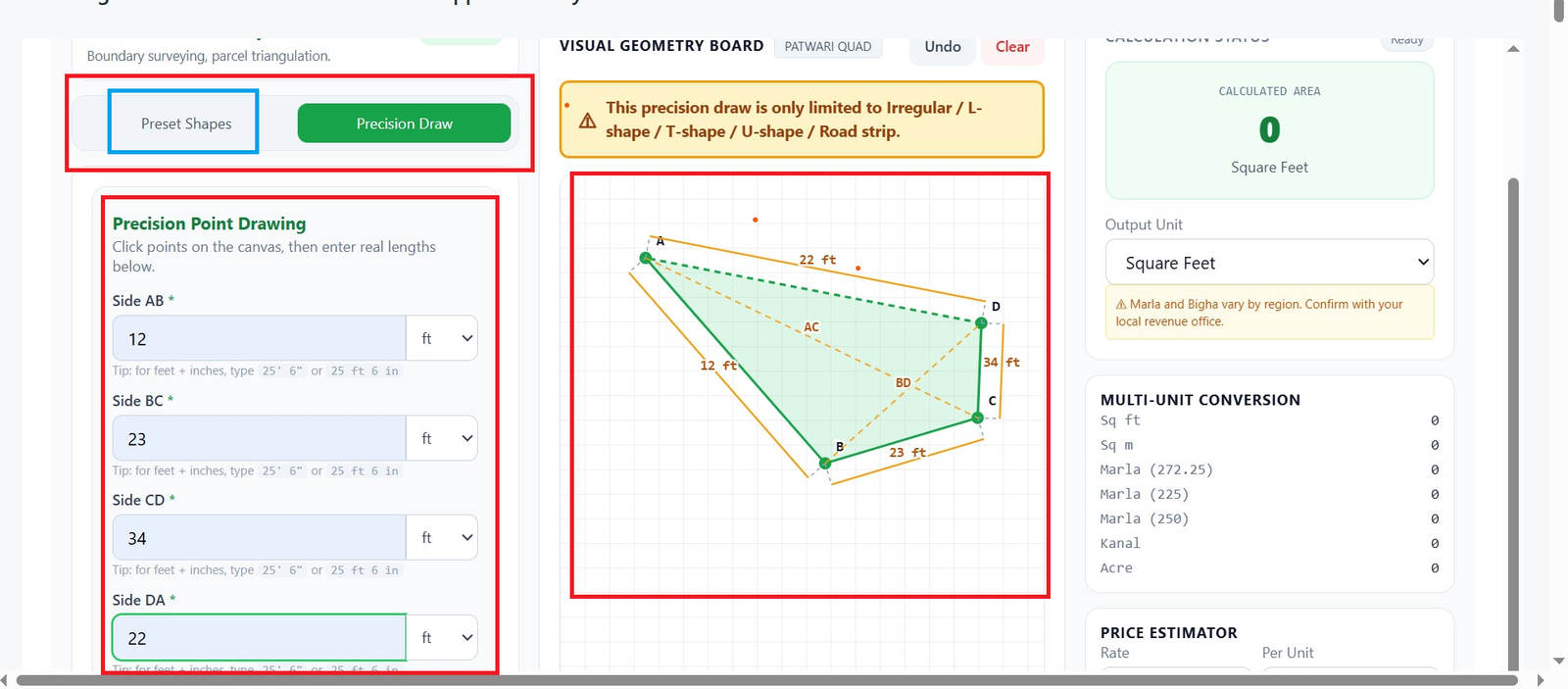
What Is an Irregular Shape?
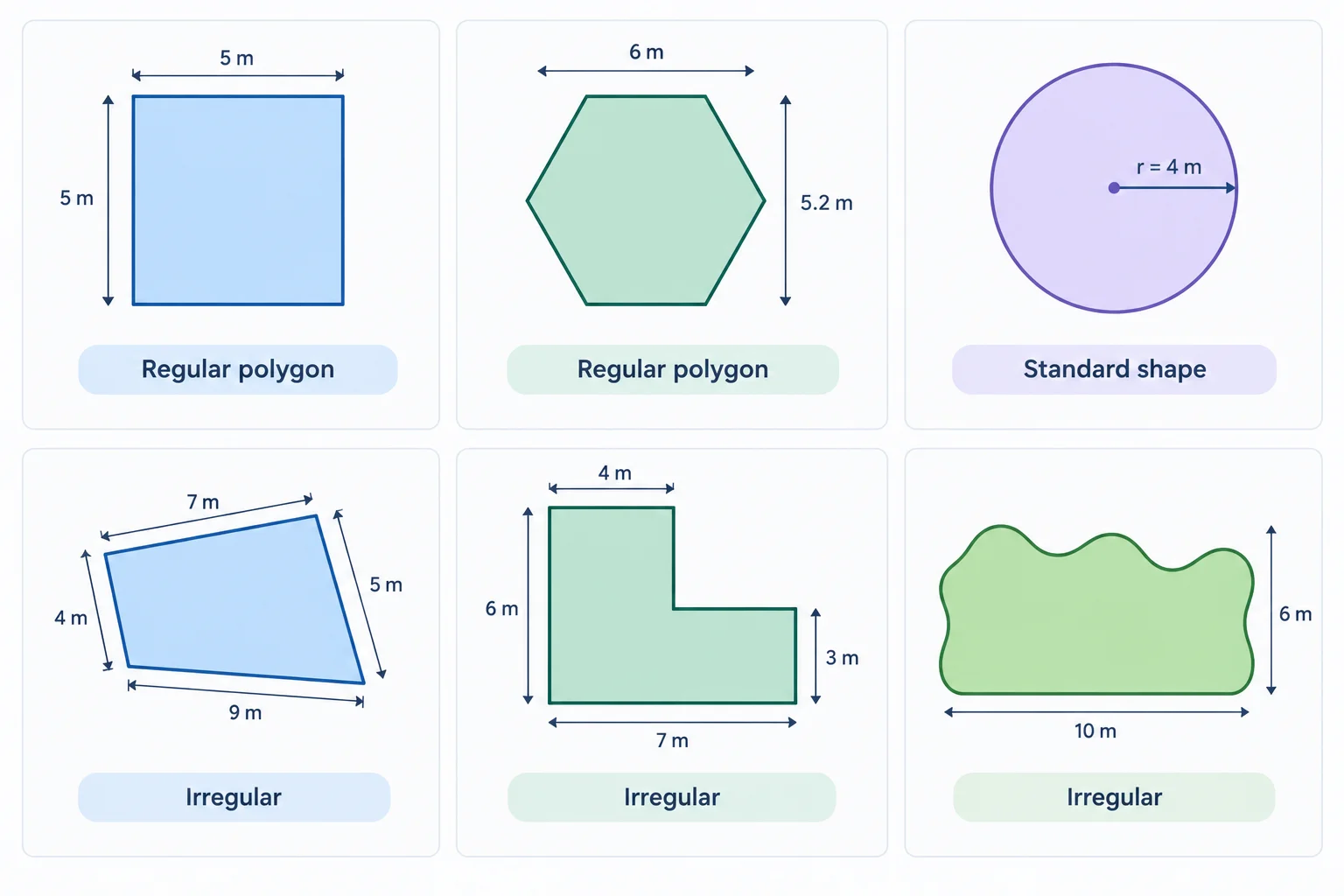
An irregular shape is a shape whose boundary does not follow a standard geometric pattern that can be described by one familiar formula. For polygons, a shape is irregular in the sense used on this page when its sides or interior angles are not all equal and no single familiar formula, such as length × width, covers it. Examples include uneven quadrilaterals, L-shaped rooms, and garden beds with curved boundaries.
Regular shapes such as squares and regular hexagons follow specific geometric rules. Irregular shapes often require you to divide the area into simpler pieces, measure additional diagonals, or use corner coordinates.
You meet irregular shapes constantly:
- A property plot with four uneven sides
- An L-shaped or T-shaped room
- A garden bed with a wavy edge
- A field that follows a road on one side
- A roof section with an angled corner
A four-sided shape that looks like a rectangle but has one skewed side is also irregular. People often say “irregular rectangle” when they have this situation, but “irregular quadrilateral” is the more accurate geometric term. Length × width gives the wrong answer when the required perpendicular height or right-angle conditions are absent.
The good news is that every irregular shape can be broken into simple pieces or approximated by its corner points. That is the idea behind every method on this page.
How to Find the Area of an Irregular Shape
There are five reliable ways to find the area of an irregular shape. The right one depends on what you know about the shape and how you measured it.
- Decomposition — split the shape into rectangles and triangles, then add the pieces.
- Triangulation — use side lengths and diagonals to build triangles, then solve each with Heron’s formula.
- Shoelace formula — use the (x, y) coordinates of every corner.
- Precision Draw — place corner points on a scaled canvas and enter the real side lengths.
- Offset method — measure perpendicular offsets along a curved boundary, then use the trapezoidal rule.
| What you know | Best Method | Result Type |
|---|---|---|
| All dimensions of a shapes with square corners | Decomposition | Exact |
| All sides plus enough diagonals | Triangulation (Heron’s formula) | Exact |
| Corner coordinates from a survey or map | Shoelace formula | Exact |
| A rough outline with measured dimensions | Precision Draw | Estimated, or exact with enough diagonals (up to six corners) |
| A curved boundary measured along a baseline | Offset Method | Approximate |
| Side lengths only, for a general quadrilateral or polygon | Obtain diagonals, angles or corner coordinates | Area is not uniquely determined from side lengths alone |
That last row matters for any polygon with four or more sides. Four side lengths can form many different shapes, so they do not fix a single area. You need at least one diagonal or the angles. This is why triangulation works when side-only methods fail. A triangle is different — its three side lengths do determine its area exactly.
How to Calculate Area of Irregular Shapes — Decomposition Method
Decomposition means cutting a shape into pieces you already know how to measure. You find each area, then add them. This is the method most people use in daily life, and it works best when the shape has square corners, such as an L-shaped room, a T-shaped plot, or a U-shaped courtyard.
Worked example: flooring for an
L-shaped living room
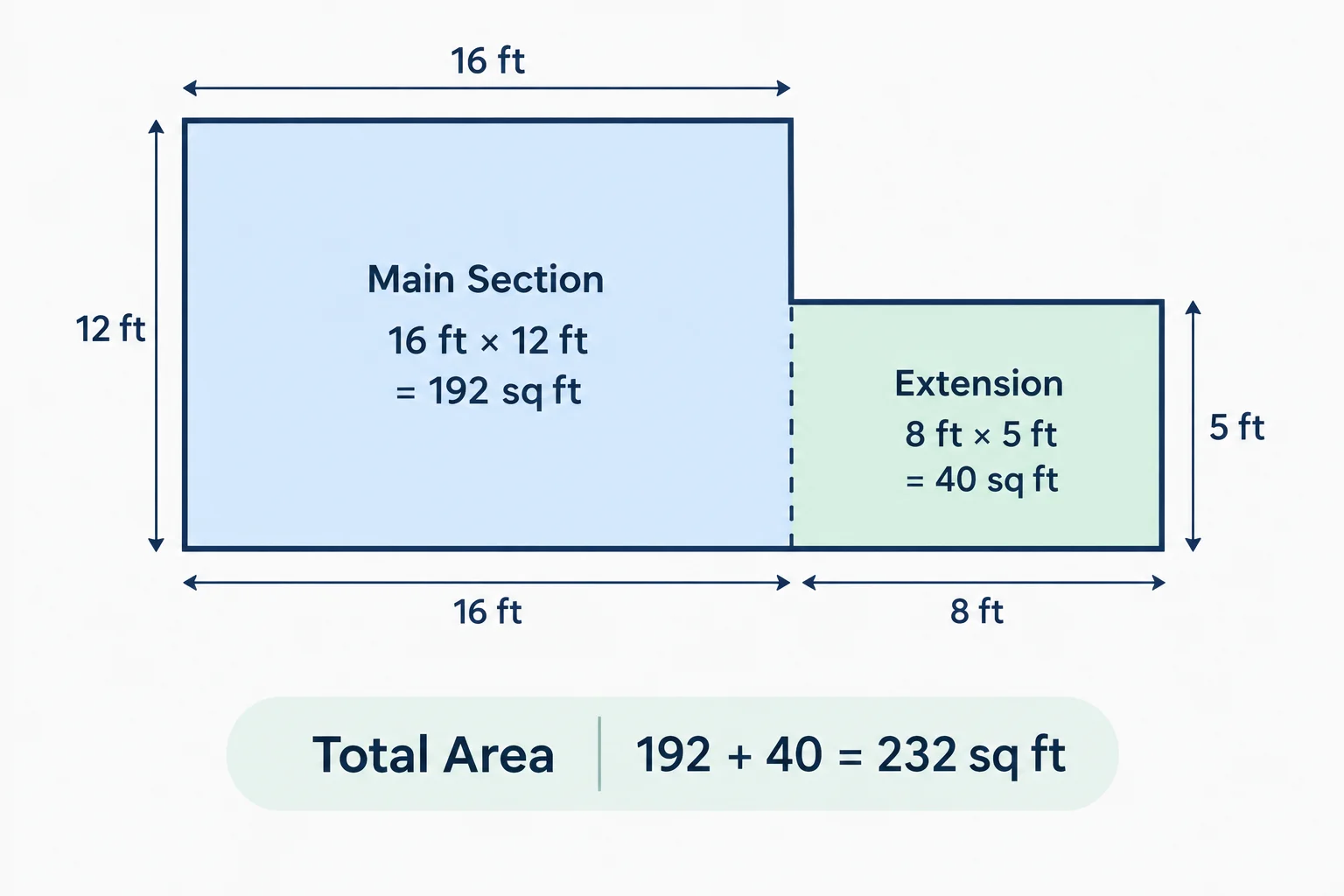
A homeowner is ordering flooring for an L-shaped living room. The main section measures 16 ft by 12 ft. The extension measures 8 ft by 5 ft.
- Main section: 16 × 12 = 192 sq ft
- Extension: 8 × 5 = 40 sq ft
- Total floor area: 192 + 40 = 232 sq ft
- Add 10% for cuts and waste: 232 × 1.10 = 255.2 sq ft
The homeowner should order about 256 sq ft of flooring.
You can cut the same shape another way, and you should still get 232 sq ft. That is a quick way to check your work. A shape with a missing corner can also be handled by subtraction: measure the full outer rectangle, then subtract the notch. When the pieces are curved, decomposition gives only an estimate.
Triangulation With Sides and Diagonals
Triangulation splits a many-sided shape into triangles by measuring diagonals. A triangle is the one shape that is fully fixed by its three side lengths, so each triangle has exactly one area. Add the triangle areas and you have the area of the whole plot. Use it for land plots with four or more uneven sides.
Heron’s formula
Heron’s formula gives a triangle’s area from its three sides, a, b, and c, with no angles needed:
- s = (a + b + c) ÷ 2
- Area = √[ s × (s − a) × (s − b) × (s − c) ]
Worked example: an Irregular four-sided plot
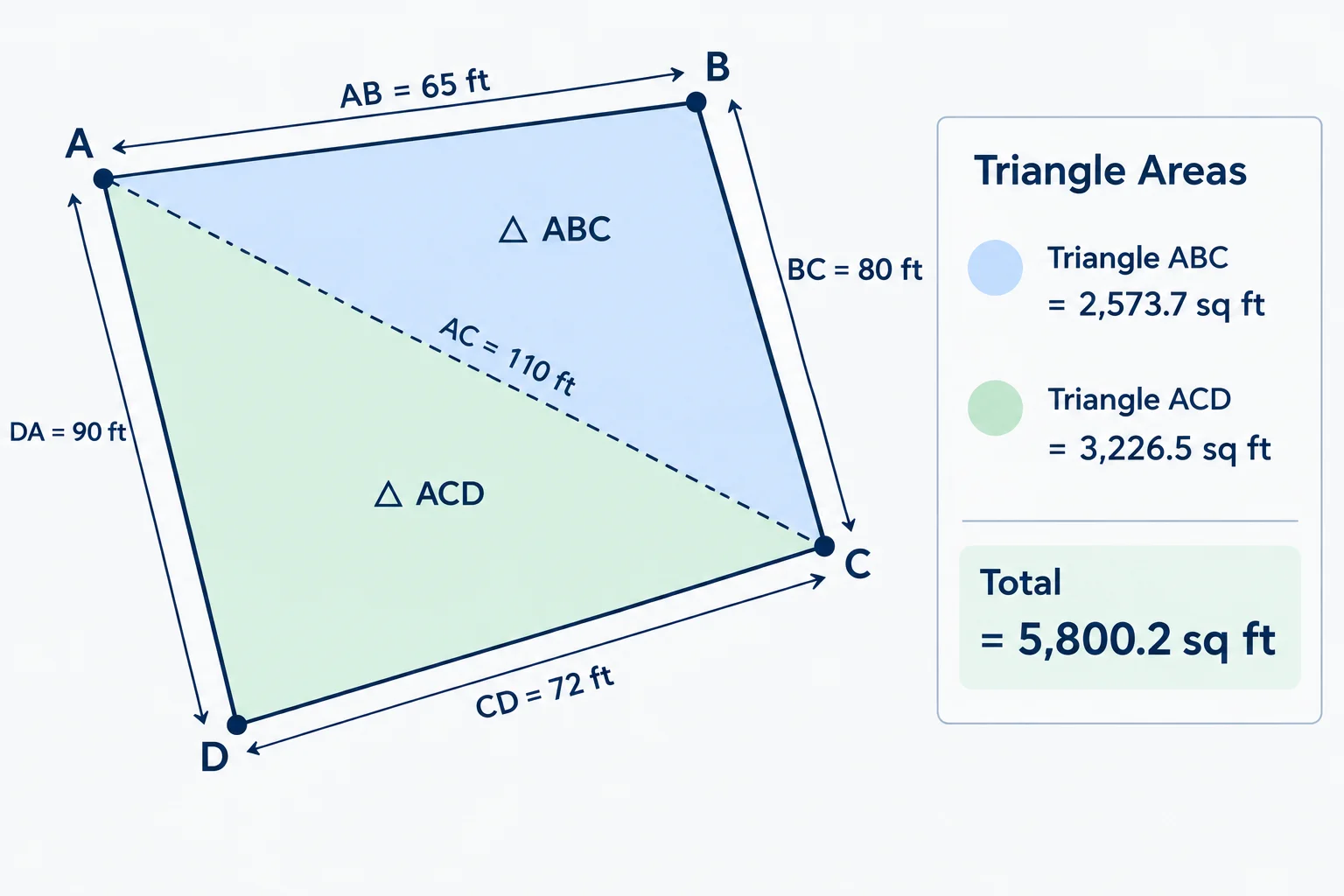
A landowner has a plot with sides AB = 65 ft, BC = 80 ft, CD = 72 ft, and DA = 90 ft. The diagonal AC measures 110 ft. This splits the plot into triangle ABC and triangle ACD.
Triangle ABC (65, 80, 110)
- s = (65 + 80 + 110) ÷ 2 = 127.5
- Area = √(127.5 × 62.5 × 47.5 × 17.5) = √6,624,023 ≈ 2,573.7 sq ft
Triangle ACD (110, 72, 90)
- s = (110 + 72 + 90) ÷ 2 = 136
- Area = √(136 × 26 × 64 × 46) = √10,409,984 ≈ 3,226.5 sq ft
Total: 2,573.7 + 3,226.5 = 5,800.2 sq ft
Precision Draw — Sketching the Boundary
Precision Draw is the method for any shape that doesn’t match a preset. Instead of entering measurements into a formula, you place a point at each corner of your shape on a digital canvas. Then you enter the real-world length of each side. For an estimate, the tool measures the drawn polygon and scales it so its perimeter matches the total of your side lengths, so draw the outline as close to scale as you can.
This method works when:
- You have measured every side but have no angles or coordinates
- You want to sketch the outline first and refine it
- The shape has more than four sides and none match a preset
How to use it
- Switch to Precision Draw mode.
- Click the canvas at each corner of your shape. The tool labels them A, B, C, and so on.
- In the input panel, a field appears for each side — AB, BC, CD, and so on.
- Enter the real-world length of each side, in the same unit.
- Optional but recommended: enter diagonals. The tool displays up to five diagonal input fields, prioritising those from a single corner. With the required diagonals from the first corner entered, on shapes with up to six corners, the tool returns an exact result using Heron’s formula. Without those diagonals, or with more than six corners, it estimates the area from the drawn shape.
- Click Compute Exact Area.
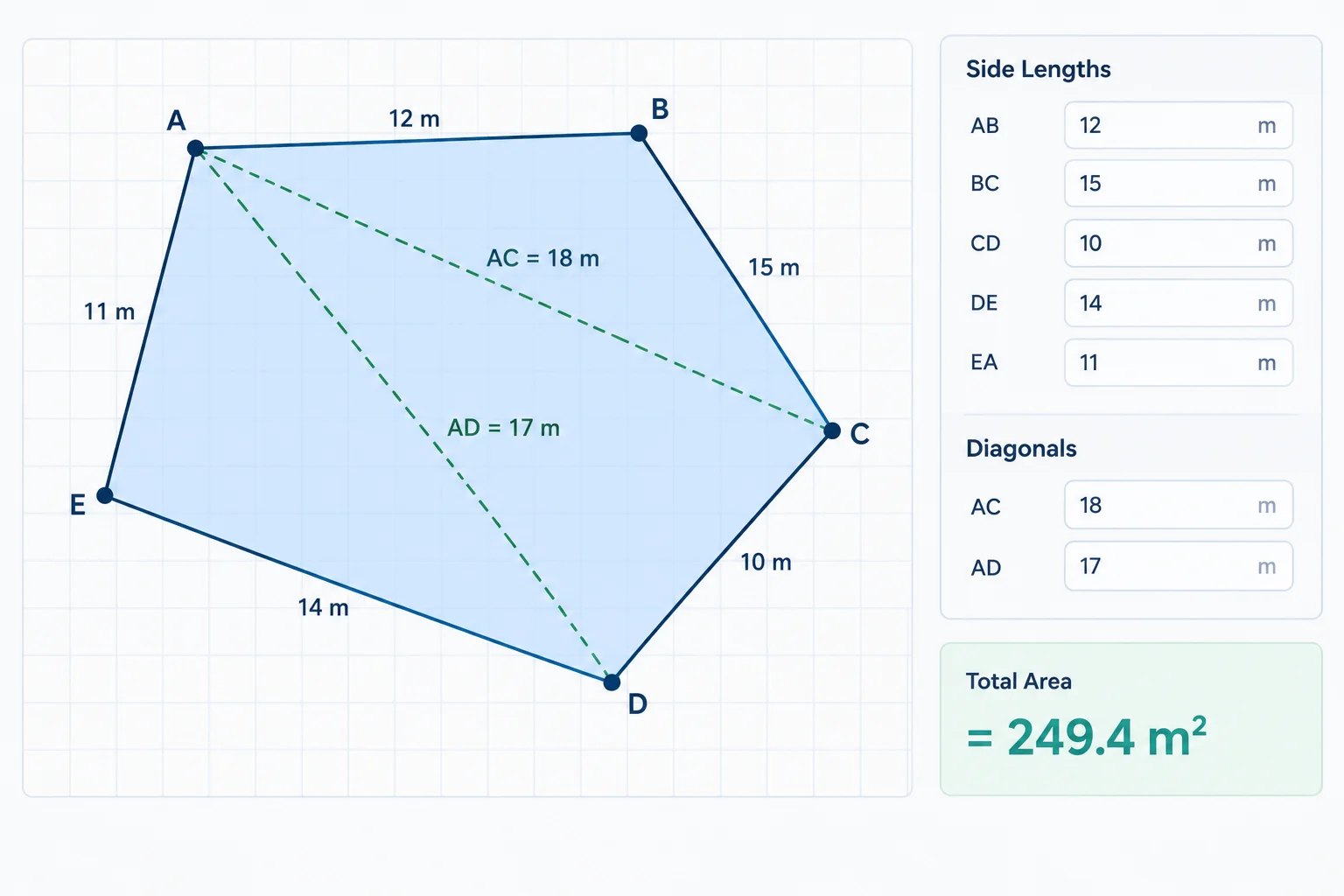
Worked example: a five-sided garden
You have a five-sided garden. You measure each side with a tape:
- AB = 12 m
- BC = 15 m
- CD = 10 m
- DE = 14 m
- EA = 11 m
You measure two diagonals from corner A:
- AC = 18 m
- AD = 17 m
Place five points on the canvas at the corners. Enter the side lengths and the two diagonals.
The tool splits the garden into three triangles from corner A:
- Triangle ABC: sides 12, 15, 18 → about 89.3 sq m
- Triangle ACD: sides 18, 10, 17 → about 83.4 sq m
- Triangle ADE: sides 17, 14, 11 → about 76.7 sq m
Total: about 249.4 sq m.
Understanding the result label
- Exact — the required valid side lengths and diagonals are available for the supported triangulation.
- Estimated — the area is approximated from the drawn shape because sufficient diagonal measurements are missing or the shape has more than six corners.
An exact mathematical calculation does not guarantee that the original field measurements are accurate. If the sides or diagonals were measured incorrectly, the formula will still produce a mathematically correct result from those wrong numbers. Always cross-check your measurements before relying on the result.
Shoelace Formula — Finding Area From Corner Coordinates
The shoelace formula finds the area of a polygon from the (x, y) coordinates of its corners. It is also called Gauss’s area formula or the surveyor’s formula, because surveyors use it with measured points. The name comes from the criss-cross pattern of the multiplications, which looks like lacing a shoe.
For corners listed in order, multiply each x by the next y, subtract the next x times the current y, add those results around the shape, take the absolute value, and divide by 2.
The most common mistake is vertex order. List the corners in the order you would walk around the boundary, clockwise or counterclockwise. Jumping across the shape gives a wrong answer. A shape whose edges cross each other (self-intersecting) will also give a meaningless result.
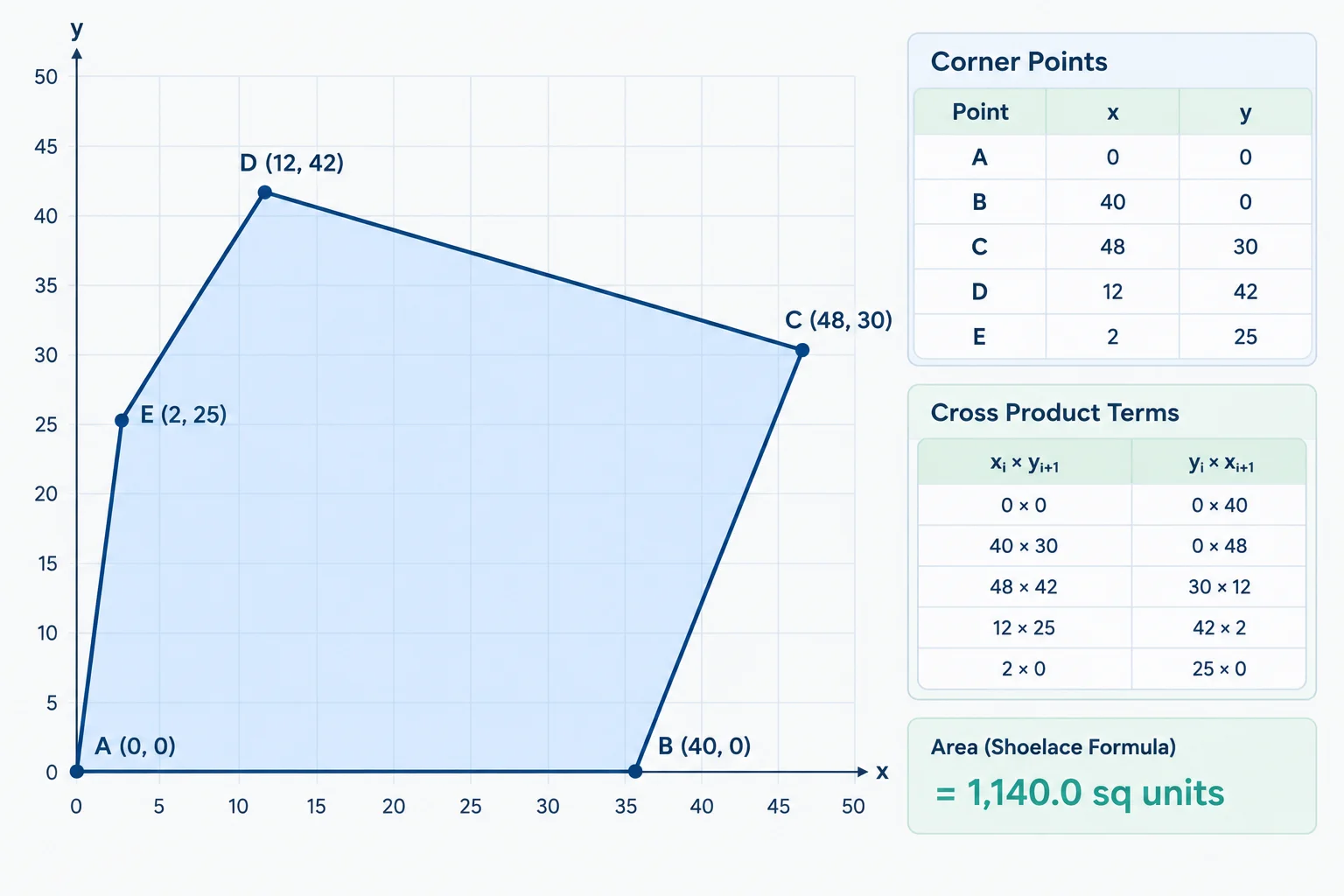
Worked example: a five-sided plot (coordinates in meters)
Corners: (0, 0), (40, 0), (48, 30), (12, 42), (2, 25).
| Step | Calculation | Result |
|---|---|---|
| (0,0) → (40,0) | 0×0 − 40×0 | 0 |
| (40,0) → (48,30) | 40×30 − 48×0 | 1200 |
| (48,30) → (12,42) | 48×42 − 12×30 | 1656 |
| (12,42) → (2,25) | 12×25 − 2×42 | 216 |
| (2,25) → (0,0) | 2×0 − 0×25 | 0 |
| Sum | 3,072 |
Area = 3,072 ÷ 2 = 1,536 sq m. That equals about 0.38 acres (1 acre is 4,046.86 sq m).
Note about this calculator. This tool does not accept coordinates directly. But the method is worth understanding. If you have surveyed coordinates, you can compute the area by hand using this formula.
Offset Method — Handling Curved and Wavy Boundaries
When one edge of a shape follows a river, road, or hedge, straight-side methods stop working. Surveyors use the offset method. Lay a straight baseline along one side of the shape, then measure perpendicular distances (offsets) from the baseline to the curved edge at equal intervals.
The trapezoidal rule turns those offsets into area. Treat each strip between two offsets as a trapezoid, then add them:
Area ≈ interval × [ (first offset + last offset) ÷ 2 + all the offsets in between ]
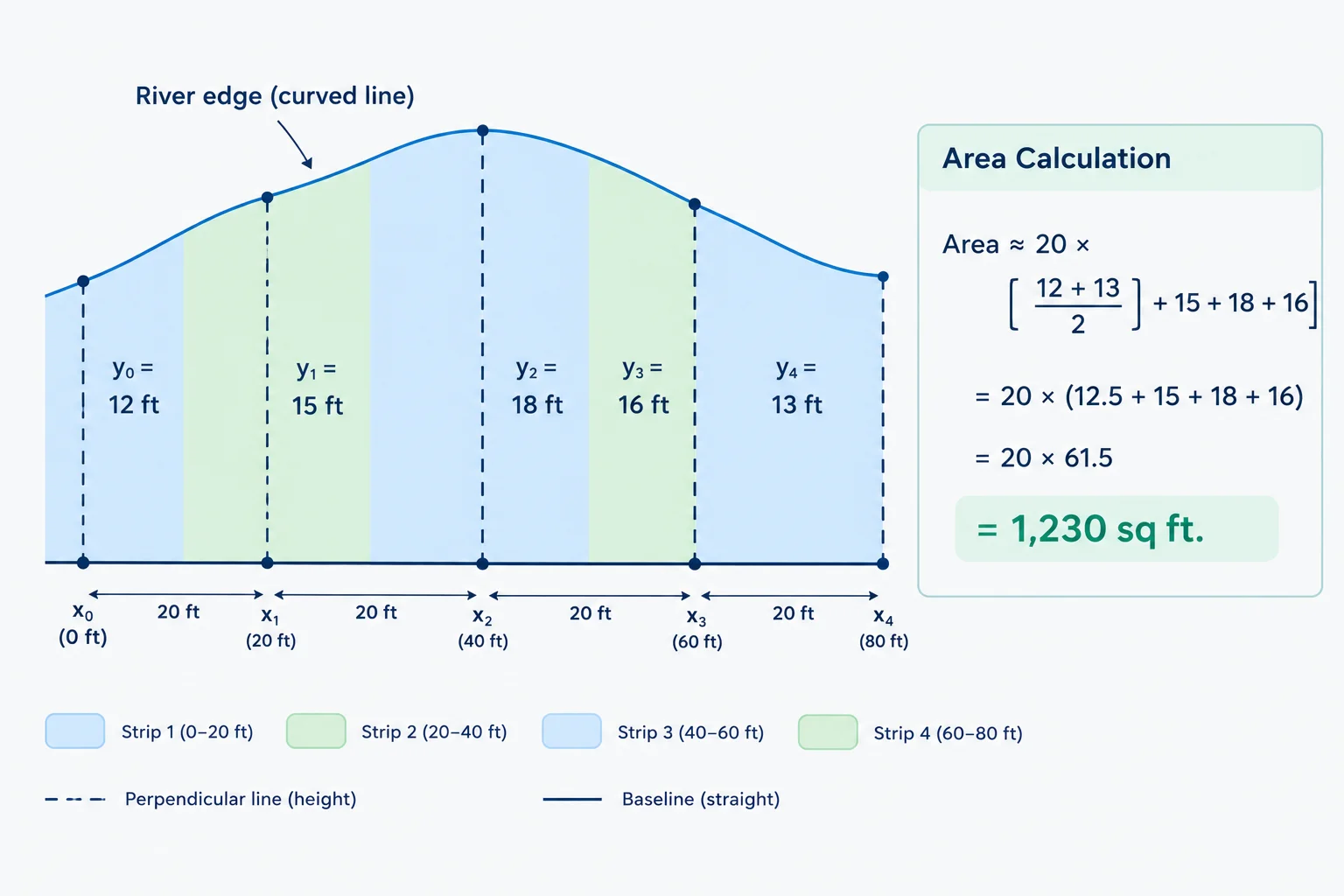
Worked example: a farm boundary along a river
An 80-foot baseline runs along the straight edge of a farm plot. The offset to the river edge is measured every 20 feet:
- y₀ = 12 ft
- y₁ = 15 ft
- y₂ = 18 ft
- y₃ = 16 ft
- y₄ = 13 ft
There are five offsets, so four intervals of 20 ft each. The baseline runs 80 ft (four intervals × 20 ft).
Apply the trapezoidal rule:
- Half of the two end offsets: (12 + 13) ÷ 2 = 12.5
- Middle offsets: 15 + 18 + 16 = 49
- Sum: 12.5 + 49 = 61.5
- Area ≈ 20 × 61.5 = 1,230 sq ft
Accuracy
The trapezoidal rule gives an approximation. Accuracy improves with:
- Shorter intervals between offsets
- More offset points at curves
- A baseline that stays straight
For legal property boundaries along a curve, a licensed surveyor’s measurement is the correct source. This method is useful for planning, not for deeds.
Note about this calculator. This tool does not have a dedicated offset-method mode. But you can approximate a curved boundary by placing extra points along the curve in Precision Draw. Adding points where the boundary changes direction can improve the approximation, provided the points represent the actual boundary accurately. The result remains an estimate and depends on the measurements and the shape of the boundary. Each extra point needs its own measured side length.
Draw any shape, browse 30+ presets, and price land in your currency.
The Master Area Calculator includes freehand mode, composite mode, and land rate calculation across 45 currencies — no sign-up required.
How to Choose the Right Method
These five methods cover many common situations. Here is a decision guide.
| What You Have | Method | Where to do it |
|---|---|---|
| A shape that splits into rectangles and triangles | Decomposition | Calculator preset, or by hand |
| All sides plus one or more diagonals | Triangulation | Calculator Precision Draw, or by hand with Heron’s formula |
| The (x, y) coordinates of every corner | Shoelace formula | By hand, or a coordinate-based tool |
| A rough outline with measured dimensions | Precision Draw | Calculator Precision Draw |
| A curved boundary measured with offsets | Offset Method | By hand with the trapezoidal rule |
For most real-world land and room measurements, the choice comes down to two questions:
- Do you have coordinates? → Use the shoelace formula.
- Do you have measured sides and diagonals? → Use triangulation.
If the answer to both is no, use Precision Draw to estimate.
Combining methods
Some shapes need more than one method. A plot might have one straight side and one curved side. Use triangulation for the straight-sided portion and the offset method for the curved portion, then add the results. This is standard practice in land surveying.
Measuring an Irregular Plot or Land: Complete Guide
Most errors in irregular land area come from poor field measurement, not from the math. Work through these steps in order and the calculation becomes straightforward.
Step 1: Walk the Boundary and Record Every Side
Walk the edge of the plot and measure each side from corner to corner. A 30 m or 100 ft tape works for small plots, a laser distance meter is faster, and a GPS app helps on large open land. GPS apps are suitable for rough estimates, not for legal boundary measurements. Mark each corner with a stake or flag first, and label them A, B, C, and so on in order.
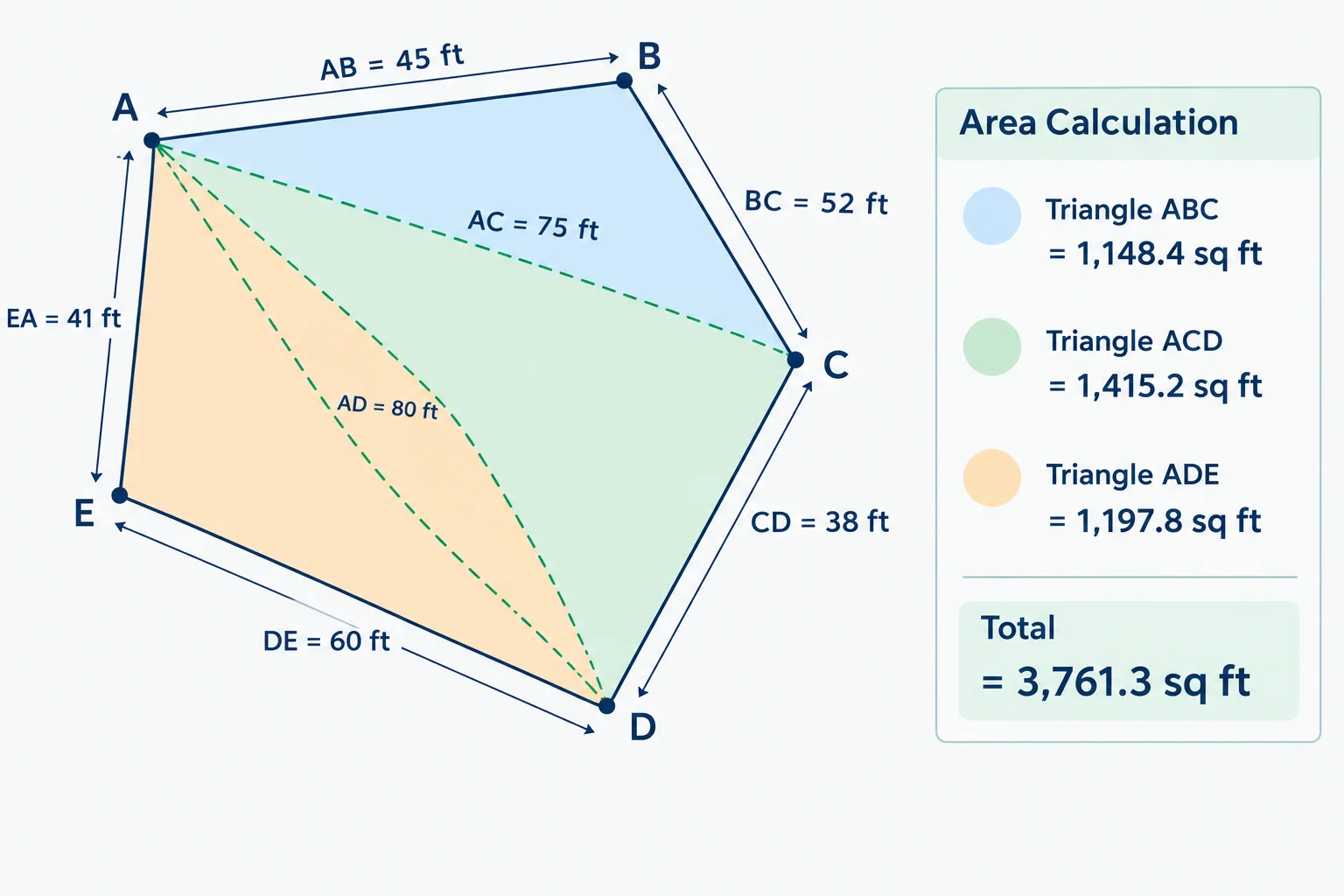
Here is a recorded five-sided boundary:
| Side | Length |
|---|---|
| AB | 45 |
| BC | 52 |
| CD | 38 |
| DE | 60 |
| EA | 41 |
Measure along the ground in straight lines. If the tape sags or bends around an obstacle, the number will be too high. On sloping ground, measure the horizontal distance instead, since ground distance overstates the area.
Step 2: Measure at Least One Diagonal
Side lengths alone do not lock the shape. Diagonals do. Measure from one corner to the other corners, so each diagonal cuts the plot into triangles. A plot with n sides needs n − 3 diagonals from a single corner.
For the five-sided plot above, two diagonals from corner A are enough:
- AC = 75 ft
- AD = 80 ft
Pick diagonals that stay inside the plot. A diagonal that passes outside the boundary will break the triangle method. In Precision Draw, the first corner you click becomes corner A, and the tool fans every triangle from it. Click first at a corner from which every diagonal stays inside the plot. The calculator does not check this, so a wrong choice can still show an Exact result.
A note on the fan-triangulation method. This approach requires at most five diagonals for polygons with up to eight vertices. The calculator displays up to five diagonal input fields, prioritising those from a single corner, but it shows at most three diagonals from corner A. That is enough for an exact result on shapes with up to six corners. For polygons with more than six vertices, the calculator returns an estimate, so you may need to divide the shape into smaller parts or use coordinates.
Step 3: Choose Your Method Based on the Shape
| Shape Type | Method | Why |
|---|---|---|
| Rectangle with a notch or L, T, U shape | Decomposition | Square corners make rectangles easy |
| Four-sided plot, uneven sides | Triangulation, 1 diagonal | Two triangles, exact result |
| Five or more sides, flat boundary | Triangulation, several diagonals | One corner fans out into triangles |
| Corner coordinates from a survey | Shoelace formula | Exact, no diagonals needed |
| Curved edge (river, road, hedge) | Offset Method | Handles curves with measured offsets |
| A rough outline with measured dimensions | Precision Draw | Fast estimate using measured sides |
Step 4: Worked Example for a 5-Sided Plot
Using the sides and diagonals above, split the plot into three triangles from corner A: ABC, ACD, and ADE.
Triangle ABC (45, 52, 75)
- s = 86
- Area = √(86 × 41 × 34 × 11) = √1,318,724 ≈ 1,148.4 sq ft
Triangle ACD (75, 38, 80)
- s = 96.5
- Area = √(96.5 × 21.5 × 58.5 × 16.5) = √2,002,652 ≈ 1,415.2 sq ft
Triangle ADE (80, 60, 41)
- s = 90.5
- Area = √(90.5 × 10.5 × 30.5 × 49.5) = √1,434,639 ≈ 1,197.8 sq ft
Total area: the sum of the unrounded triangle areas gives 3,761.3 sq ft. Displayed values are rounded to 1 decimal place, so the visible sum of 1,148.4 + 1,415.2 + 1,197.8 = 3,761.4 sq ft. The difference of 0.1 sq ft is a rounding artifact, not an error.
Practical note: if you are laying turf on this plot, add 10% for trimming and uneven edges. Use the unrounded total: 3,761.3 × 1.10 ≈ 4,137.4 sq ft. Do the same for grass seed, and check the coverage printed on the bag.
Step 5: Verify Your Result
Always cross-check. Cut the plot a second way, for example fanning from corner C instead of A, and compare the totals. They should agree within a small margin. If they do not, a measurement is wrong. Remeasure the diagonals first, since one wrong number there shifts the whole answer.
Also remeasure one diagonal and recalculate. If the area changes noticeably, that measurement needs another look.
Hire a licensed surveyor when the area affects a sale, a deed, a boundary dispute, a building permit, or a tax record. A calculator gives you a good working figure, but only a survey is legal evidence.
Irregular Polygons: Pentagon to Decagon
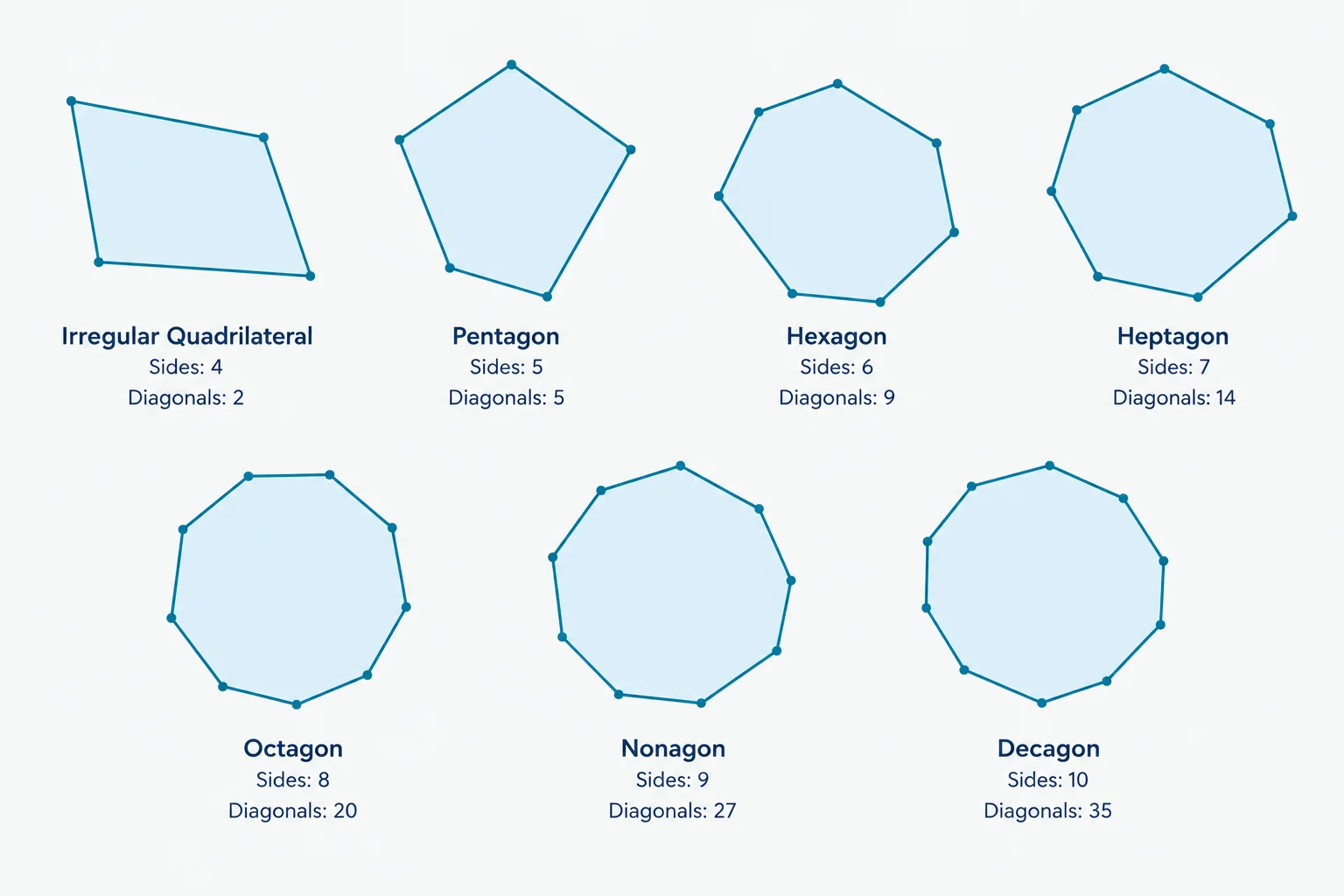
An irregular polygon is any closed shape with straight sides that are not all equal. The method stays the same however many sides it has: split it into triangles or use coordinates. The number of diagonals grows quickly, which is why coordinates become attractive for shapes with many corners.
The number of diagonals in a polygon with n sides is n(n − 3) ÷ 2.
| Shape | Sides | Diagonals | Common real-world use |
|---|---|---|---|
| Irregular quadrilateral | 4 | 2 | Standard building plots |
| Irregular pentagon | 5 | 5 | Corner lots, small gardens |
| Irregular hexagon | 6 | 9 | Farm parcels, large garden beds |
| Irregular heptagon | 7 | 14 | Land with several boundary bends |
| Irregular octagon | 8 | 20 | Pavilion floors, large plots |
| Irregular nonagon | 9 | 27 | Detailed property outlines |
| Irregular decagon | 10 | 35 | Complex survey parcels |
You do not need every diagonal. From a single corner you need only n − 3. A hexagon needs three diagonals from one corner, giving four triangles. If you have coordinates, skip diagonals entirely and use the shoelace formula for any irregular hexagon area or irregular pentagon.
Accuracy, Limits, and When Not to Use This Area of Irregular Shapes Calculator
Exact mathematical results can be obtained from supported preset shapes and valid triangulations with sufficient measurements. Coordinate-based methods such as the shoelace formula can also produce exact polygon areas when applied correctly, although this calculator does not accept coordinates directly.
Estimated results can occur in Precision Draw when the required diagonals are missing or the shape has more than six corners, and the area is inferred from the drawn shape. Treat them as planning figures.
Common sources of error:
- Wrong vertex order: the shoelace formula needs corners in walking order.
- Self-intersecting shapes: edges that cross produce an unreliable area.
- Diagonals outside the plot: on a dented (concave) plot, a diagonal that runs outside the boundary can still produce a result labeled Exact, in Precision Draw and in the Irregular Quadrilateral preset. The calculator does not check this.
- Too few curve points: a smooth curve approximated with five points will cut corners.
- Unit mistakes: mixing feet and meters, or using the wrong Marla size.
This tool is not a legal survey. Measured area can differ from the area written on a deed, because deeds may be old, rounded, or based on different boundary rules. If the two disagree and it matters, a licensed surveyor settles it.
Frequently Asked Questions
How do I calculate the area of an irregular shape?
Split it into rectangles and triangles and add their areas, use side lengths with diagonals and Heron’s formula, or use corner coordinates with the shoelace formula. For curved edges, use the offset method. For quick estimates, use Precision Draw.
Is there an area formula for irregular shapes?
No single formula covers every irregular shape. The shoelace formula calculates a polygon’s area from its ordered corner coordinates. Heron’s formula calculates a triangle’s area from its three side lengths. For a curved boundary measured at intervals along a baseline, the trapezoidal rule can approximate the area using the measured offsets.
How to find area of 4 unequal sides?
Four side lengths alone don’t determine the area — the shape can flex into many quadrilaterals. You need one more measurement. The easiest is a diagonal, which splits the shape into two triangles you can solve with Heron’s formula. A 4-sided plot with sides 65, 80, 72, and 90 ft, plus a 110 ft diagonal, has an area of about 5,800 sq ft.
Can I calculate area from perimeter?
Not for a general or irregular shape. Many different shapes share the same perimeter but have different areas — a square and a narrow rectangle, for example. You can find the area from the perimeter only for a square, a circle, or a regular polygon, where the perimeter determines the side length or radius. For a general quadrilateral or polygon, you need at least one additional measurement: a side, a diagonal, an angle, or corner coordinates.
How do I find the area of an irregular pentagon?
Measure the five sides and two diagonals from one corner. That gives three triangles. Solve each with Heron’s formula and add them.